

Did you know that approximately 7.5 million children in the United States alone are affected by speech and language disorders? This is a staggering number that highlights a real challenge faced by many parents, especially those who want their children to engage with the Quran. For these children, learning to recite the Quran, with its unique Arabic phonetics and precise pronunciation, can feel like an overwhelming task. The beauty of the Quran lies not only in its meaning but also in its sound, making accurate recitation a crucial aspect of learning.
For children with speech and language disorders—such as speech delays, articulation issues, and other language-based difficulties—reciting the Quran can be especially challenging. Arabic has sounds that are unfamiliar to many, and the specific rules of Tajweed (the science of Quranic pronunciation) require a level of precision that can be hard to achieve. For parents, watching their child struggle with mispronunciations or slow progress can be frustrating and emotionally taxing. But here’s the good news: there are effective strategies that can make this journey not only manageable but also meaningful.
Phonetic-based strategies, which focus on the sounds and pronunciation of words, are incredibly beneficial for children with speech and language disorders. These strategies are not just about memorizing words; they involve teaching children how to break down sounds, understand the nuances of pronunciation, and gain confidence in their recitation. With the right tools, children with speech and language difficulties can still experience the profound connection that comes with reciting the Quran, while building their self-esteem and communication skills.
In this article, we’ll delve into the science behind phonetic learning, and explore why it’s such an important tool for children with language challenges. We’ll also discuss practical, research-backed strategies that can make Quranic recitation an achievable and enjoyable process. By focusing on phonetics, we can help children not only improve their recitation but also develop a deeper connection with the Quran—one that is both spiritual and empowering. Through patience, practice, and the right approach, children with speech and language disorders can confidently embark on their Quranic learning journey. Let’s explore how!
The Problem Statement
Learning to recite the Quran is a beautiful journey for many kids, but for those with speech and language disorders, it can feel like an uphill battle. The tricky part is that Quranic Arabic has sounds that don’t exist in many other languages, so kids who aren’t native speakers of Arabic have a tough time getting the pronunciation just right.
Kids with speech delays, articulation problems, or phonological issues often struggle with the precision needed for Quranic recitation. They might mispronounce words, skip over them, or get stuck halfway through a verse. And while they might be trying their best, these little hiccups can lead to frustration, a hit in confidence, and a feeling of distance from the Quran. Instead of feeling proud of their recitations, they might start avoiding them.
What makes it even trickier is phonemic awareness—the ability to pick apart and play with sounds in words. It’s a crucial skill for speaking and reading, but for kids with speech disorders, it can be a big barrier. Arabic is a whole different beast in this department, with its complex sounds and structure. It’s not like English or many other Western languages, so it’s extra hard for kids who are already struggling with basic speech skills.
This all leads to one big issue: kids can end up feeling disconnected from the Quran, and it can be tough for parents to know how to help. But don’t worry—there’s hope! With the right phonetic strategies, these challenges can be tackled, and the Quran can become something kids can engage with confidently and joyfully. It’s all about finding the right tools to make the recitation feel more natural and less frustrating.
Research-Based Data: Speech and Language Disorders in North America
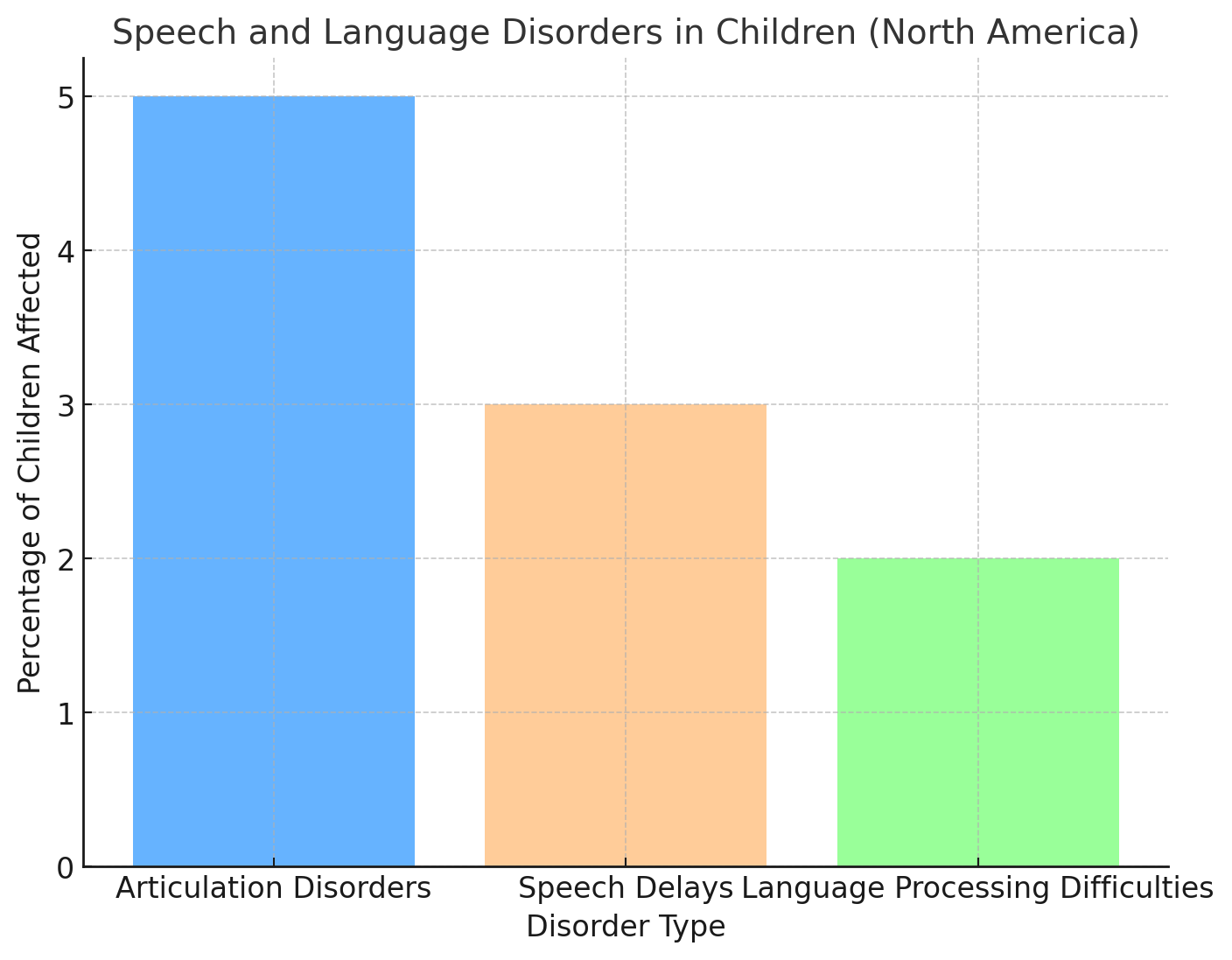
Speech and language disorders are some of the most common developmental challenges that children face in North America. According to the National Institute on Deafness and Other Communication Disorders (NIDCD), about 10% of children in the U.S. experience speech and language delays, and this number is steadily increasing. These issues are particularly significant for children who are learning Arabic as a second language, since Arabic has unique phonetic features that many other languages, including English, do not have.
The research indicates that children with speech delays, articulation disorders, and language processing difficulties often struggle with several key areas that are crucial for language development, and even more so when learning Quranic recitation:
Phonological Awareness: This is the ability to recognize and manipulate the sounds in words, which is vital for decoding words and getting the pronunciation right. In the context of Quranic recitation, it becomes a significant barrier because Arabic has many sounds that are unfamiliar to children who speak English or other languages.
Auditory Discrimination: This refers to the ability to distinguish between similar sounds. Since Arabic has sounds that don’t exist in many Western languages, this skill is essential for children to correctly pronounce words. Without good auditory discrimination, kids may confuse sounds, leading to mispronunciations.
Speech Fluency: Many children with speech disorders find it difficult to produce clear and fluent speech. This can make reciting the Quran especially challenging, as the recitation requires not just accuracy but also a smooth flow of words, with each syllable articulated properly.
One study conducted by Speech and Language Pathology Services found that children who struggle with articulation often benefit significantly from phonetic training. This type of training helps them to produce difficult sounds more clearly, improving both speech clarity and fluency. The study suggests that these same phonetic strategies can be highly effective in improving Quranic recitation, helping children overcome pronunciation hurdles and boosting their confidence in their recitation abilities.
So, while speech and language challenges can make Quranic recitation more difficult, research shows that with the right phonetic training and targeted approaches, children can improve their pronunciation and fluency, making their Quranic journey more successful and enjoyable.
Key Issues and Problems Faced by Children with Speech and Language Disorders in Quran Recitation
Phonetic Challenges:
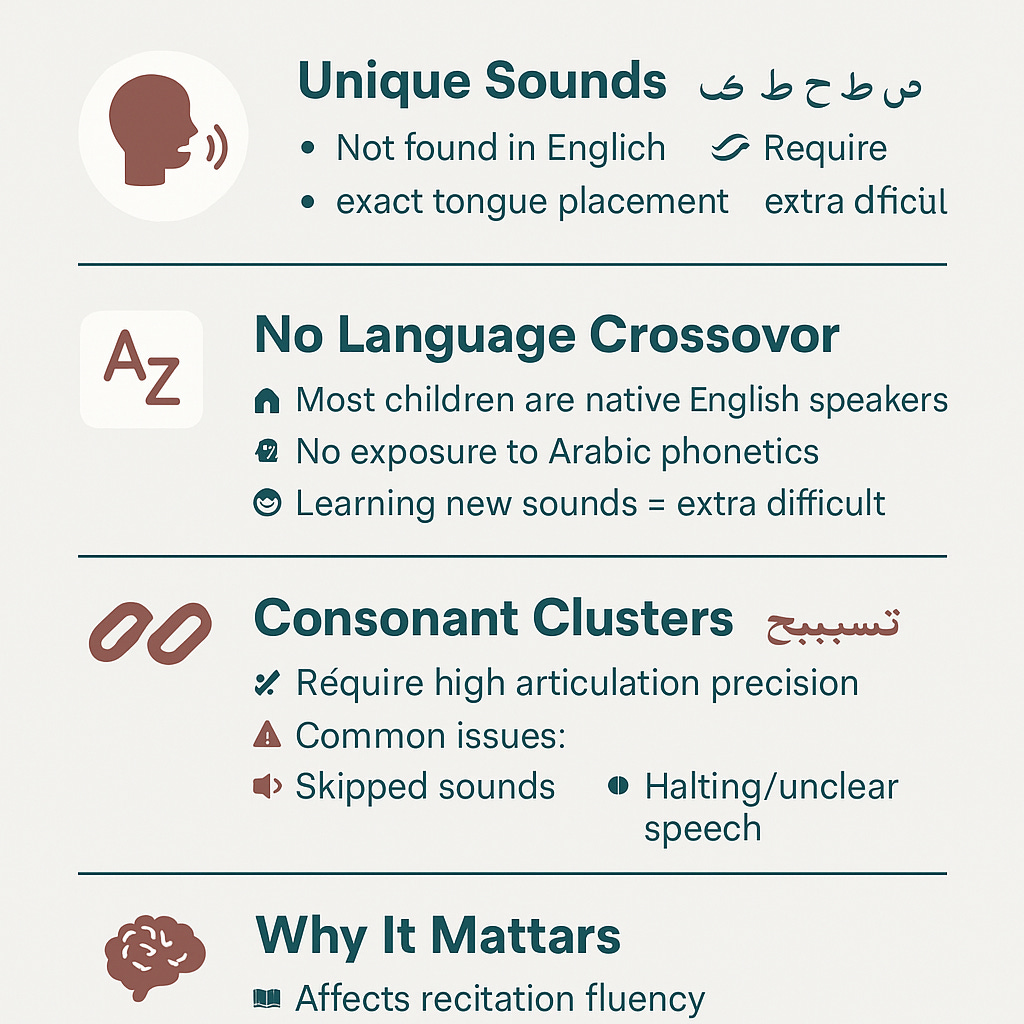
Arabic contains a wide range of letters and sounds that are unique and don't have direct equivalents in many other languages, especially English. For children with speech and language disorders, this presents a significant challenge. For example, letters like ص (Sad), ط (Ta), and ع (Ayn) are produced with specific articulations that are difficult for children to master. These letters require precise tongue placement and airflow control, which many children with speech delays or articulation disorders struggle to achieve. The absence of similar sounds in their first language (usually English) means they don’t have any prior experience or familiarity with these phonetic features, making learning them harder.
Additionally, Arabic words frequently feature consonant clusters, where two or more consonants appear together without intervening vowels. These clusters are common in Arabic, and they can be tough for children who struggle with articulation. For example, words like “تسبيح” (Tasbeeh) or “قرآن” (Quran) require a level of precision in pronunciation that children with speech difficulties may find hard to replicate. The challenge lies in articulating these clusters clearly, as their speech systems may not yet be developed enough to combine consonants smoothly. This can cause mispronunciations or halting speech, making it difficult for children to complete a recitation properly.
Speech Delays and Mispronunciations:
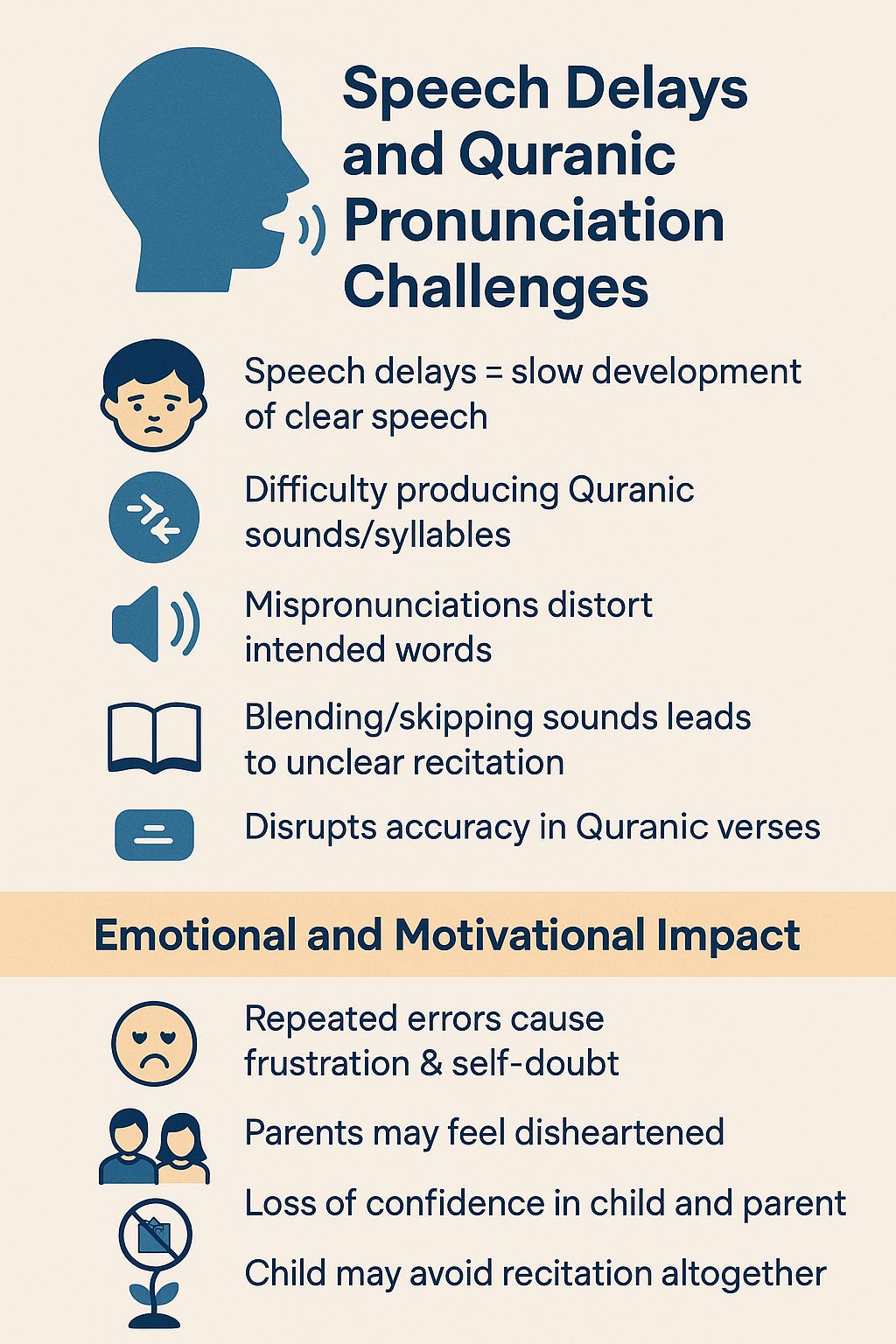
Children with speech delays often face significant struggles when it comes to pronouncing Quranic words accurately. These delays may manifest in slow development of clear speech patterns, making it difficult for children to produce certain sounds or syllables as needed in Quranic recitation. In many cases, children might pronounce words in a way that sounds different from the intended pronunciation, which can disrupt their ability to recite verses correctly. For example, children may distort the sounds of certain letters or blend words together, which makes their recitations less clear or unintelligible to others.
This issue is not just a technical challenge—it can also affect a child’s motivation and confidence. When children mispronounce words repeatedly, it can lead to frustration and self-doubt, as they struggle to meet the expectations of accurate recitation. Parents, too, may feel disheartened seeing their child struggle. Mispronunciations can feel discouraging for both the child and the parent, leading to a loss of confidence and a reluctance to continue practicing. Without proper support and strategies, children might begin to avoid reciting the Quran altogether, which can stunt their spiritual growth and engagement with the text.
Lack of Phonetic Awareness:
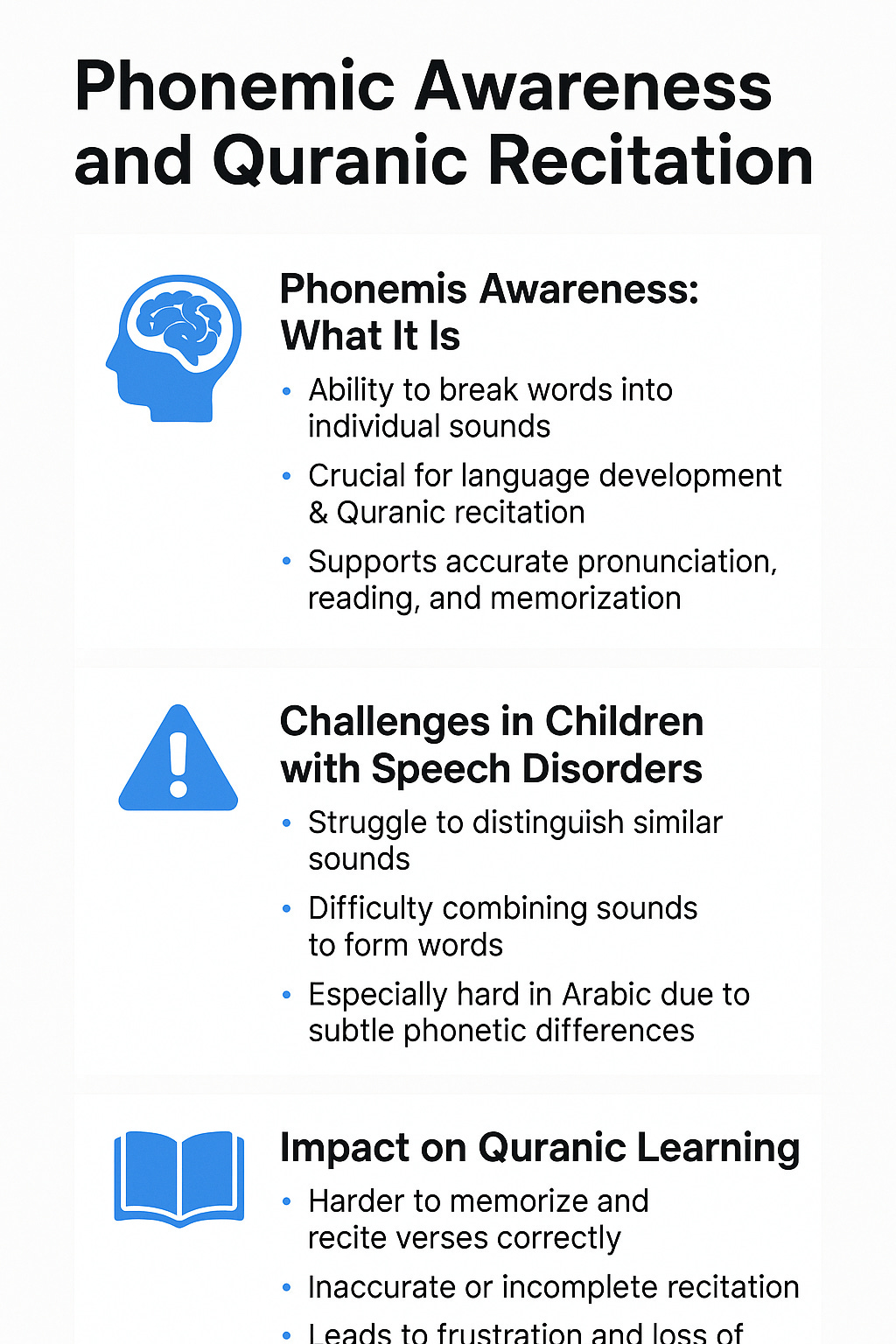
Phonemic awareness is the ability to break down words into individual sounds, and it is an essential skill for both language development and Quranic recitation. This skill helps children understand how sounds fit together to form words, which is crucial for accurate pronunciation, reading, and memorization. However, children with speech disorders often struggle with this skill. They may find it hard to distinguish between similar sounds or fail to recognize how different sounds combine to form words. This issue becomes particularly prominent when learning Arabic, as the language has many subtle phonetic differences that are unfamiliar to children.
The difficulty in phonemic awareness can make memorizing and reciting Quranic verses accurately much harder. Since Arabic words are phonetically rich and require precise sound formation, children who struggle with phonemic awareness may have trouble remembering the exact sounds or syllables in each word. As a result, their recitations may be incomplete or incorrect, leading to a feeling of frustration. This struggle with phonemic awareness also makes it challenging for children to grasp the full meaning of the Quranic verses they are reciting, as they are focused on the mechanics of pronunciation rather than the beauty and depth of the words themselves.
Self-Esteem and Motivation:
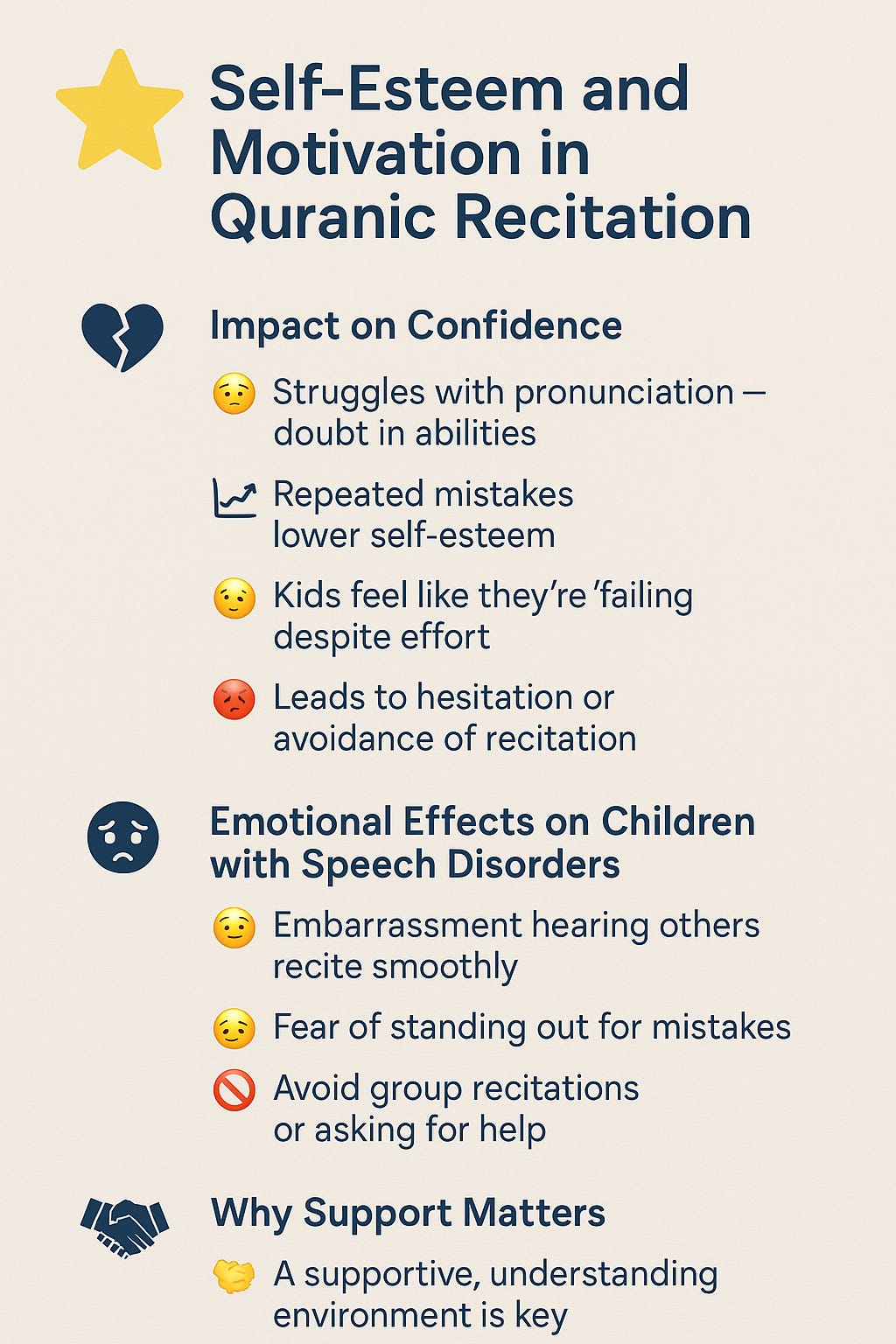
The challenges of mastering Quranic recitation, especially when it comes to pronunciation, can take a toll on a child’s self-esteem. Kids who struggle to produce the correct sounds and experience repeated mispronunciations may start to feel that they are not capable of learning the Quran. This can affect their self-confidence and make them hesitant to engage in future recitations. If the child consistently hears that their recitation isn’t "right," they may feel like they’re failing, even though they are putting in effort. This feeling of inadequacy can lead to a lack of motivation to continue practicing or learning.
For children with speech and language disorders, the emotional impact of struggling with pronunciation can be even more pronounced. These children may feel embarrassed or self-conscious when they hear other children recite smoothly, and they may worry that their mistakes will make them stand out in a negative way. This sense of embarrassment can discourage them from participating in group recitations or seeking help when they need it. Over time, this lack of confidence can hinder their progress, making it harder for them to stay motivated or even enjoy the learning process. It's crucial to create a supportive, understanding environment where children feel encouraged to keep trying, regardless of the obstacles they face.
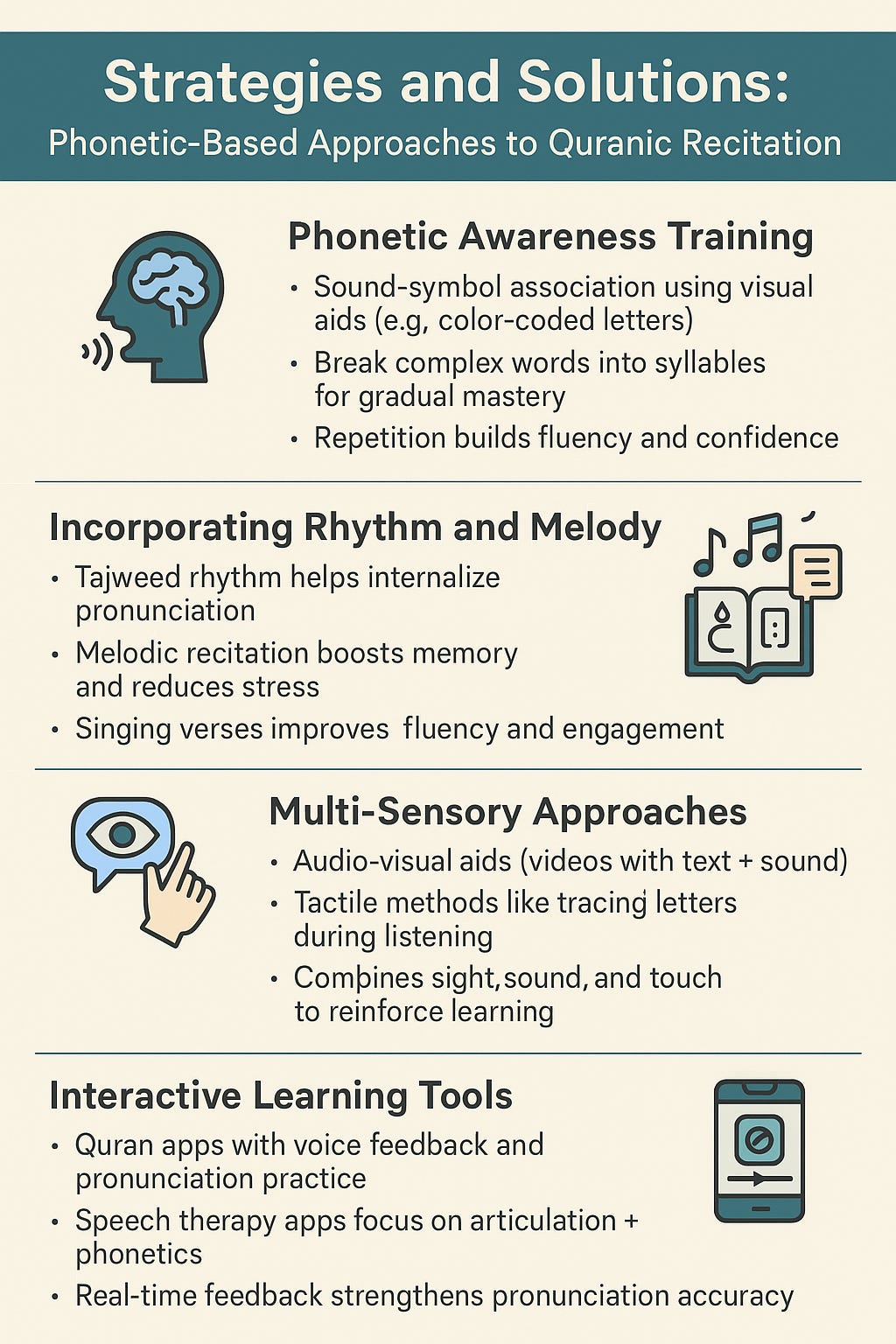
Strategies and Solutions: Phonetic-Based Approaches to Quranic Recitation
Phonetic Awareness Training:
One effective strategy to support children with speech and language disorders in Quranic recitation is sound-symbol association. This method helps children connect Arabic letters with their corresponding sounds in a way that is visually engaging. For example, using color-coded flashcards or visual aids can make the sounds more distinguishable and memorable. By assigning specific colors to certain letters—like using red for sounds such as ع (Ayn) or ح (Ha)—children can more easily differentiate between these complex sounds and remember their correct articulation. This visual reinforcement aids in strengthening their phonetic awareness, making it easier for them to recall and pronounce the letters accurately during recitation.
Along with sound-symbol association, articulation practice is essential. Breaking down complex Quranic words into smaller syllables allows children to focus on mastering one sound at a time, helping them gradually improve their pronunciation. Repetition is key in this process, and consistent practice over time will help children become more comfortable with the sounds of the Quran. By starting with simple words and slowly building up to more complex phrases, children will be able to progressively refine their speech. The goal is to make the sounds feel more natural through frequent repetition, thus boosting their confidence and fluency with Quranic recitation.
Incorporating Rhythm and Melody:
Incorporating rhythm and melody into Quranic recitation is another strategy that can help children with speech and language disorders. Tajweed, the set of rules governing the proper pronunciation of Arabic letters in the Quran, naturally includes rhythm and melody. This built-in musicality can make it easier for children to memorize and pronounce Quranic verses. By practicing recitation with a rhythmic approach, children can internalize the phonetics through melody, making the sounds feel more familiar and easier to replicate. This method also makes the learning process more enjoyable and less intimidating, as it engages both their auditory and musical skills, which can be more accessible for some children.
Encouraging children to sing Quranic verses can be another helpful tool. Singing, or at least reciting in a melodic pattern, allows children to focus on the phonetic sounds in a relaxed, enjoyable way. The melody helps smooth out the process of pronunciation, making it easier for children to remember the words and their correct sounds. Singing also has the added benefit of improving fluency and recall, as the rhythm of the melody reinforces the sounds in the child’s memory. This method can be particularly engaging and fun, helping children stay motivated and eager to continue their recitation practice.
Multi-Sensory Approaches:
Multi-sensory approaches are particularly beneficial for children with speech and language disorders because they engage more than one sense, helping reinforce learning. One example is using visual aids such as videos with both audio and text. These videos allow children to see the written words while also hearing the correct pronunciation. The visual component supports the phonetic understanding by showing them how the letters look and how they are pronounced in context. This combination of sight and sound helps the child associate the shape of the letters with their correct sounds, making it easier for them to retain the information and pronounce the words accurately.
In addition to visual aids, tactile methods can be incredibly effective in reinforcing phonetic learning. By having children trace the Quranic letters while listening to the recitation, they engage their sense of touch, further linking the written words to their sounds. This kinesthetic approach not only helps with phonetic understanding but also aids in memorization, as it taps into a different part of the brain that processes physical movement. The more senses that are involved in the learning process, the more likely it is that the child will internalize the sounds and gain confidence in their ability to recite the Quran correctly.
Interactive Learning Tools:
Interactive learning tools are another great resource for helping children with speech disorders. Quran apps, such as those designed for recitation, can be particularly helpful. These apps often provide both visual and auditory feedback, allowing children to hear accurate recitations and practice along. Some apps even include features like voice recognition, which gives immediate feedback on pronunciation, allowing children to correct mistakes in real time. This type of instant feedback can help children fine-tune their recitations and build their confidence as they progress in their learning. Apps like Ayat recitation apps are perfect for offering children an engaging, interactive way to practice, making Quranic recitation feel like a fun, personalized experience.
In addition to Quran apps, speech therapy tools and programs that focus on articulation and phonetic training can be incredibly beneficial for children with speech disorders. Many speech therapy apps are designed specifically to help children practice difficult sounds and refine their pronunciation skills. By incorporating these tools into their Quranic learning, children can benefit from targeted exercises that reinforce their ability to produce clear, accurate speech. These interactive programs can be used alongside Quran recitation practice, providing children with a comprehensive learning experience that strengthens both their speech and their connection to the Quran.
Creating a Positive, Encouraging Learning Environment:
Creating a positive and encouraging learning environment is essential for children with speech and language disorders, as it fosters a sense of achievement and keeps them motivated to keep going. One of the best ways to do this is by celebrating small wins. Every time a child successfully pronounces a word or completes a verse, no matter how minor the achievement seems, it’s important to acknowledge and celebrate it. This reinforces the child’s confidence and encourages them to continue practicing, knowing that their efforts are recognized. The more the child feels supported, the more likely they are to stay motivated and push through the challenges of Quranic recitation.
Finally, daily practice with patience is key to helping children improve their recitation. Rather than expecting perfection from the start, focus on consistency and gradual improvement. Short, focused practice sessions each day are far more effective than long, overwhelming sessions that might lead to burnout or frustration. By breaking down the recitation process into manageable pieces and practicing regularly, children can build their skills without feeling overwhelmed. This consistent practice will help them gain confidence over time and feel competent in their recitation, leading to a deeper connection with the Quran and its message.
The Phonetic Path
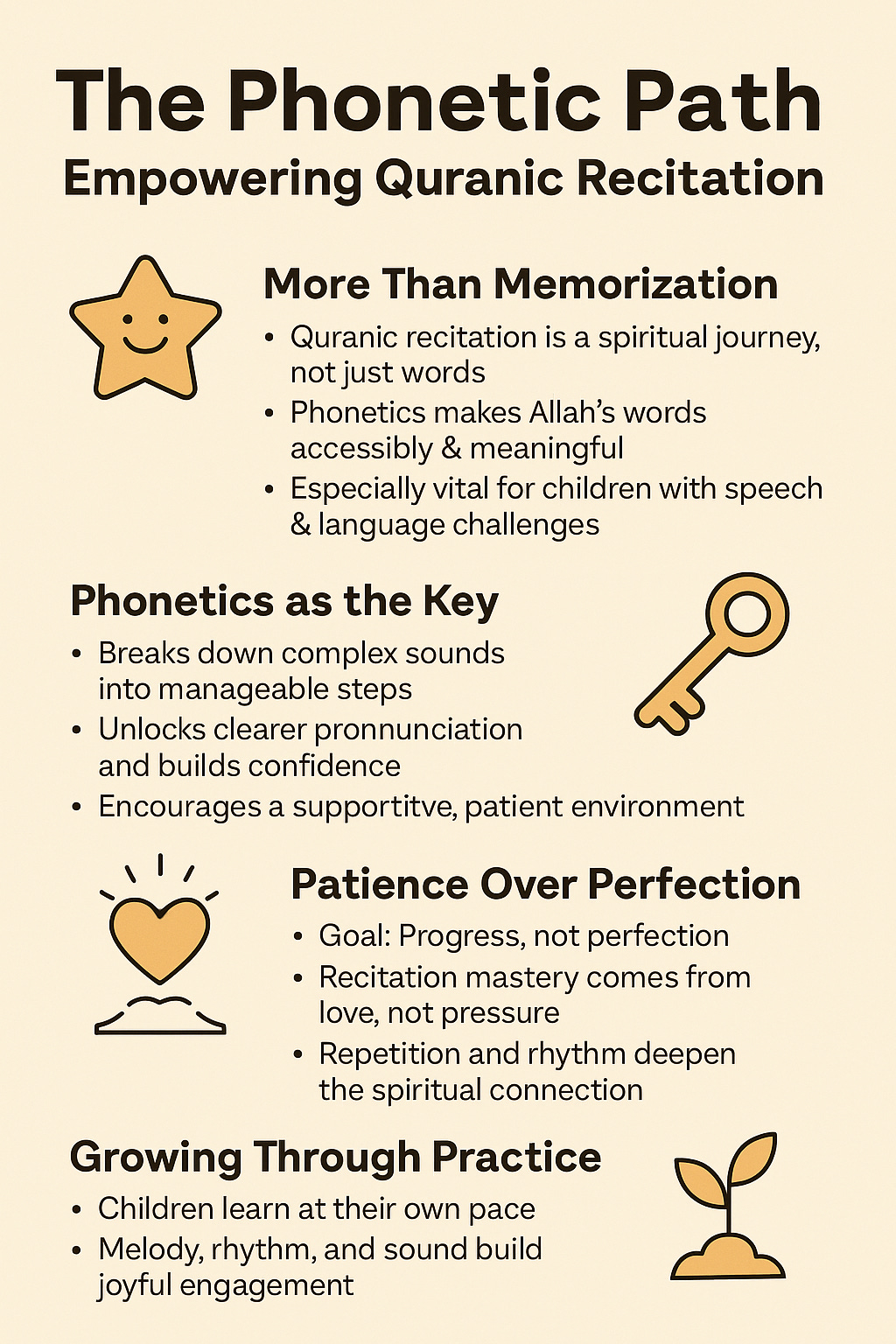
Quranic recitation is not just about memorizing verses—it's a spiritual journey that connects the heart to the divine. For children with speech and language disorders, this journey can feel like an obstacle course. But with the right tools and strategies, particularly when focusing on phonetics, this journey becomes one of empowerment and joy. Phonetics isn’t just a boring academic subject—it’s a powerful tool that opens up a world of possibility, making the recitation of Allah’s words more accessible and meaningful for children who face speech challenges.
At its core, phonetic training is all about breaking down sounds in a way that children can understand and master. It’s like giving them a key to unlock the beauty of the Quran, helping them pronounce words clearly and with confidence. For parents, embracing phonetic-based strategies is a way to create a supportive, patient environment where children feel encouraged to take their time, practice without fear, and ultimately find joy in the recitation. Phonetics becomes the bridge between the child’s current abilities and their potential to connect with the Quran on a deeper level.
However, this isn’t about striving for perfection—it’s about passion and patience. The goal isn’t to create flawless recitations overnight. Instead, it’s about fostering a love for the Quran, nurturing that love through consistent practice, and gradually building confidence in recitation. As children practice the sounds, the rhythm, and the melody of Quranic verses, they begin to experience the beauty of the words, even before they’ve mastered them. The journey of phonetic learning may be slow at times, but with every step forward, the bond with the Quran grows stronger. And in time, that love for the Quran will lead to mastery, not through pressure, but through patience, practice, and deep faith.
A Step Forward in Your Child’s Success
Parents, are you ready to embark on a meaningful journey to support your child's Quranic learning? Now is the perfect time to take the first step! Start by incorporating small, manageable phonetic practice sessions into their daily routine. Begin with focusing on one sound at a time, breaking it down into simple, achievable goals. This process may feel gradual, but remember, every step forward is a victory.
Embrace the beauty of this journey—each session is a building block, and with each small accomplishment, your child is growing closer to mastering the recitation of the Quran with confidence and grace. Celebrate the little wins, whether it's a perfect pronunciation or the joy in their eyes when they successfully remember a verse.
It’s important to understand that every child's journey with the Quran is unique. They may progress at their own pace, and that's perfectly okay. What matters is the love, patience, and consistency you bring to the process. Your dedication will help them experience the true joy and spiritual connection that comes with reciting the words of Allah.
Keep in mind that the journey is just as important as the destination. Each sound, no matter how small, is a step toward a deeper connection with the Quran. With your unwavering support and the right tools, your child will not only learn to recite but will also embrace the profound beauty of Allah’s words.
So, take that first step today. Every moment spent in learning is a moment your child is drawing closer to Allah. The journey is worth it—one sound, one word, one verse at a time.
As you continue this journey with your child, what small moments of progress have brought you the most joy? How do you celebrate those little victories together? Share your experiences, and let's support each other as we walk this path of Quranic learning with love and patience. Remember, every step is a step toward something beautiful. What will your next step be?