
He had escaped danger.
He had left his home behind.
He was travelling toward a place where he hoped Allah would guide him.
And he did not yet know what awaited him there.
His name was Musa (AS).
A prophet whose story would become one of the most remarkable stories in the Quran.
But on this particular day, he wasn’t standing before Pharaoh.
He wasn’t holding his staff before an enormous crowd.
He was simply a traveller who had reached an unfamiliar place.
And there, beside a well, he noticed something that others might easily have overlooked.
Two women were standing away from the crowd.
They had animals that needed water.
But they were waiting.
Why weren’t they watering their animals like everyone else?
Prophet Musa (AS) decided to find out.
And what happened next teaches us something beautiful about kindness.
A journey into the unknown
Before reaching the well, Musa (AS) had been living in Egypt.
But a dangerous situation had forced him to leave.
The Quran tells us that he departed in a state of fear and caution, asking Allah to save him from wrongdoing people.
Imagine having to leave the place you know.
The familiar streets.
The people you’ve grown up around.
The life you’ve always known.
And travelling somewhere new without knowing exactly what awaits you.
Musa (AS) turned toward Madyan.
As he travelled, he placed his hope in Allah’s guidance.
He prayed that his Lord would guide him to the right path.
It was a time of uncertainty.
But even during a difficult journey, Musa (AS) would soon show something important about his character.
He would notice someone else’s difficulty.
The crowded well
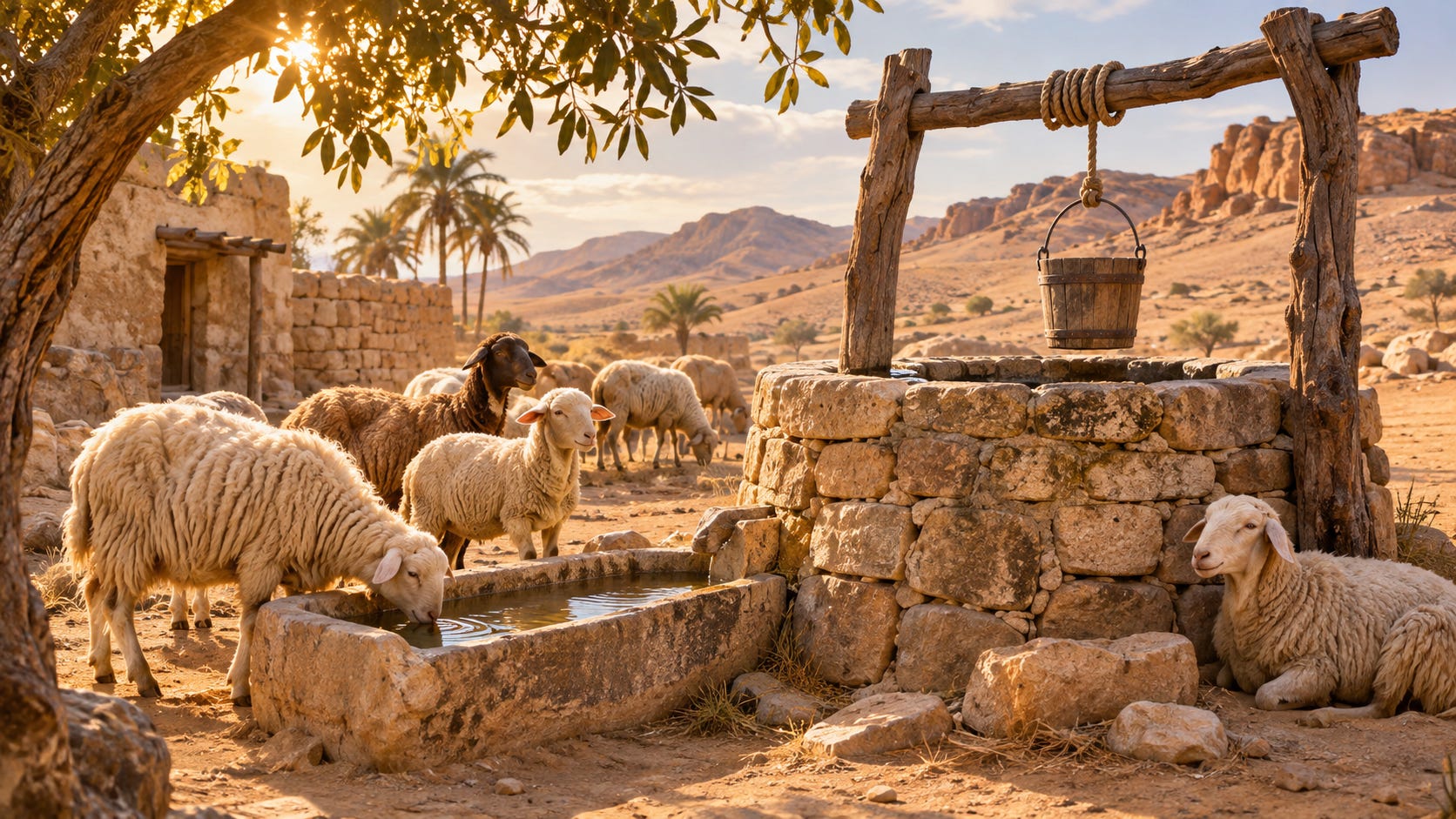
When Musa (AS) reached the water of Madyan, he found a group of shepherds watering their animals.
For people who cared for flocks, water was essential.
Their animals needed to drink.
And the well was a place where people came to provide it.
But Musa (AS) noticed something unusual.
Away from the group were two women.
They were keeping their animals back, apart from the others.
They weren’t watering them.
They were waiting.
Musa (AS) approached and asked about their situation.
The women explained that they couldn’t water their animals until the other shepherds had finished and left.
They also explained that their father was a very old man.
Now Musa (AS) understood.
The women had an important responsibility.
Their animals needed water, but they were waiting for their turn after the other shepherds.
Their elderly father couldn’t easily carry out the work himself.
Musa (AS) had only just arrived in Madyan.
He was dealing with difficulties of his own.
He could have focused entirely on his own situation.
But instead, he helped.
The small act that mattered
The Quran tells us that Musa (AS) watered the women’s animals for them.
A simple statement.
But think about what it means.
Two people needed help.
Musa (AS) noticed.
He understood their situation.
And he did something useful.
The Quran doesn’t describe a grand celebration.
There is no long speech about kindness.
No crowd gathering to praise him.
Just a person recognizing a need and helping to meet it.
Sometimes, we imagine that doing good must involve something extraordinary.
A great sacrifice.
An enormous gift.
Something everyone will remember.
But many acts of kindness are much quieter.
Helping someone carry something heavy.
Making room for a person who needs assistance.
Noticing when someone is struggling.
Offering help without waiting to be asked.
Musa’s (AS) action at the well reminds us that kindness doesn’t have to be grand to be meaningful.
And now, something else was about to happen.
Something that makes this Quranic account especially beautiful.
A prayer beneath the shade
After helping the women, Musa (AS) moved away into the shade.
He had reached Madyan after leaving a dangerous situation behind.
He had helped two strangers.
But his own future was still uncertain.
What would happen next?
Where would he find safety and stability?
The Quran tells us that Musa (AS) turned to Allah with a beautiful dua.
رَبِّ إِنِّي لِمَا أَنزَلْتَ إِلَيَّ مِنْ خَيْرٍ فَقِيرٌ
Rabbi inni lima anzalta ilayya min khayrin faqir.
“My Lord, I am truly in need of whatever good You send down to me.”
— Surah Al-Qasas, 28:24
Think about those words.
Musa (AS) did not pretend that he needed nothing.
He did not hide his dependence on Allah.
He acknowledged that whatever good Allah might provide, he was in need of it.
It was a prayer filled with humility and trust.
And it reminds us of something important.
We can help others while still needing help ourselves.
Being kind doesn’t mean we have no problems.
Being generous doesn’t mean our lives are easy.
Sometimes, we do good while carrying worries of our own.
And we can always turn to Allah with those worries.
The unexpected invitation
After Musa (AS) had returned to the shade and made his dua, something happened.
One of the two women came back to him.
The Quran describes her as approaching with modesty.
She brought a message.
Her father was inviting Musa (AS) to meet him.
He wanted to reward Musa for watering the animals.
Imagine how unexpected that must have been.
Musa (AS) had arrived as a traveller in an unfamiliar place.
He had noticed two people who needed assistance.
He had helped them.
And now their father was inviting him to speak with him.
Musa (AS) went to meet the elderly father.
He told him about what had happened and the difficult situation he had left behind.
The father reassured Musa (AS) that he had escaped the wrongdoing people.
What a meaningful reassurance that must have been during such an uncertain time.
But the story did not end there.
Strong and trustworthy
One of the women made a suggestion to her father.
She recommended that he hire Musa (AS).
And she gave an important reason.
She recognized him as someone who was strong and trustworthy.
Those two qualities matter.
Strength can help a person carry out difficult responsibilities.
Trustworthiness helps others feel confident that a person will act honestly and responsibly.
The woman had seen Musa (AS) help when help was needed.
And she recognized qualities that made him suitable for work.
The Quran then tells us that her father proposed an arrangement involving work and marriage to one of his daughters.
Musa (AS) accepted the agreement.
A new chapter was beginning in his life.
The traveller who had arrived in uncertainty was now being offered an important opportunity.
And this part of his story had begun with a moment at a well.
An act of help.
A humble prayer.
And an unexpected invitation.
We cannot know every detail of how Musa (AS) felt during those moments.
But the Quran gives us enough to recognize the beautiful lessons in what happened.
What if Musa (AS) had only thought about himself?
Let’s think about something.
When people are facing difficulties, it’s natural for them to focus on their own problems.
And sometimes, they genuinely need to rest or seek help themselves.
But Musa’s (AS) story shows us that having difficulties of our own doesn’t mean we can never notice someone else’s.
He had left Egypt in fear.
He was travelling through an uncertain time.
Yet when he reached the well, he noticed the two women waiting.
He asked what was wrong.
And he helped them.
That’s something children and adults can learn from.
You don’t have to be the strongest person in the room to be helpful.
You don’t have to be rich.
You don’t have to be grown up.
You can look for opportunities to make someone’s day easier in ways that are safe and appropriate for you.
Perhaps you help your younger brother find his missing shoes.
Perhaps you carry something for your grandmother.
Perhaps you notice a classmate struggling to collect their fallen books.
Or perhaps you simply ask someone who looks worried whether they need help.
These may seem like little things.
But little acts of care are part of good character.
There is another lesson hiding in this story
Did you notice what Musa (AS) did before helping?
He asked about the women’s situation.
He didn’t assume he understood everything.
He noticed something unusual and gave them the opportunity to explain.
That is an important part of thoughtful kindness.
Sometimes, people need help.
Sometimes, they need patience.
And sometimes, they simply need someone to listen.
We should not assume we know what another person needs just by looking at them.
A gentle question can be a good place to begin.
And when we can help appropriately, we should try.
The good we do
The story of Prophet Musa (AS) at the well is a reminder of several beautiful qualities.
Kindness toward those who need assistance.
Trustworthiness in our actions.
Humility when we turn to Allah.
And hope when we don’t know what tomorrow will bring.
But there is one lesson I hope you remember most.
You don’t have to wait until your own life is perfect before you can do something good for someone else.
Musa (AS) was facing uncertainty.
Yet he helped.
Then he turned to Allah and asked for goodness.
And the Quran tells us how the encounter became part of a new beginning for him.
Of course, doing a good deed doesn’t mean we should expect an immediate reward from another person.
We help because helping is right.
We trust Allah with the outcome.
And we remember that goodness is never something we should consider too small.
So the next time you see someone who could use a little help, think of Prophet Musa (AS).
Think of the two women waiting beside the well.
Think of his quiet act of assistance.
And remember his beautiful dua beneath the shade.
Sometimes, doing good begins with something as simple as noticing someone else’s need.
And sometimes, that small moment becomes part of a much bigger story.
🌙 A Little Reflection for Young Muslims
After reading the story, ask your child:
1. Why were the two women waiting beside the well?
They were waiting for the other shepherds to finish watering their animals, and their father was elderly.
2. What did Prophet Musa (AS) do when he learned about their situation?
He helped by watering their animals.
3. What did Musa (AS) do after helping them?
He moved into the shade and made dua to Allah.
4. What is one small way you could help someone tomorrow?
Let your child think of something realistic and safe.
Maybe helping at home, offering kindness to a classmate, or assisting a family member.
💚 A Note for Parents
This Quranic account offers a meaningful opportunity to teach children about kindness without making generosity seem like something that must always involve money, gifts, or great sacrifices.
Prophet Musa’s (AS) example shows the importance of noticing a need and taking helpful action.
It also demonstrates humility: after helping others, he turned to Allah and acknowledged his own need.
You can connect these lessons to everyday family life by encouraging children to notice when someone could use assistance, ask before helping when appropriate, and understand that doing good should not depend on receiving praise.
A meaningful question for the dinner table:
“What is one thing we can do this week to make somebody else’s day a little easier?”
Let each family member suggest an idea.
Sometimes, the smallest acts are the easiest ones to begin.
More Stories for Little Muslims 🌙
Every other week, we explore meaningful stories from the Quran and the lives of the Prophets, helping children discover lessons about faith, kindness, courage, and trust in Allah.
Between Prophet stories, enjoy our original Islamic bedtime stories, created for families to read and reflect on together.
Explore More Stories and Subscribe
Before you go, ask your child: What part of Prophet Musa’s (AS) story would you remember if you visited a well?
We’d love to hear your family’s reflections in the comments.
If this story inspired you, share it with another Muslim family.
⭐ Help your child meet the Prophets in the Quran itself
Every Prophet story your child loves is in the Quran. With a patient one-on-one teacher, they can learn to read those ayat themselves, starting with the very first letters.
White Friday: 12% off every month, for as long as you learn with us. Enroll by December 15.