

“Your patience today lights their path to the Quran tomorrow.”
Imagine this: your child is fidgeting at the dinner table again, their schoolwork is half-finished, and you’ve already reminded them three times to put away their shoes. The diagnosis reads ADHD, and suddenly, every part of your parenting takes on a new dimension—school strategies, daily routines, behavior plans. It’s overwhelming.
But amid all of this, another quiet question lingers in the back of your mind: Will my child ever connect with the Quran the way I hope they will?
Being Muslim parents, our deepest desire isn't just to raise successful children—but to raise spiritually grounded ones. Children who know Allah, who find comfort in His words, who carry the Quran in their hearts as a guiding light. When a child is diagnosed with Attention-Deficit/Hyperactivity Disorder (ADHD), our focus understandably shifts to helping them manage daily tasks and educational hurdles. Yet, in the noise of coping and caring, we must remember that spiritual development is not an afterthought—it’s foundational.
The Quran isn’t only for children who sit still. It’s for every child. Including yours.
Every child—regardless of their neurodiversity—has the right to connect with the Quran in a way that makes sense for them. And as parents, it's not just our responsibility but our honor to help them build that connection. With the right understanding, practical strategies, and a heart full of faith and patience, we can nurture a love for the Quran in children with ADHD.
Today, in this article, we will explore:
A brief overview of ADHD as a neurodevelopmental disorder.
How it affects attention, impulse control, and working memory—skills crucial for learning.
How ADHD impacts learning in general and in Quranic education specifically
Prevalence and Global Statistics of ADHD
Core learning challenges for children with ADHD
Innovative and Previously Unexplored Strategies to Support Quran Learning for Children with ADHD
Understanding ADHD and Its Impact on Learning
Picture a child who can’t seem to sit still during storytime, blurts out answers before the question is finished, or constantly drifts off in the middle of a lesson. It’s not that they don’t care. It’s not that they’re not trying. Their brain just works differently.
ADHD—Attention-Deficit/Hyperactivity Disorder—is a neurodevelopmental condition that affects millions of children worldwide. It's marked by ongoing patterns of inattention, hyperactivity, and impulsivity that go beyond typical childhood behavior. These traits aren’t just “phases” or “bad habits”—they are real, brain-based challenges that can significantly impact a child’s ability to function in daily life.
In the context of learning, ADHD can make even simple tasks feel overwhelming. Children with ADHD may:
Struggle to focus for extended periods, especially on tasks that require repetition or stillness.
Find it difficult to follow multi-step instructions or retain what they’ve just learned.
React impulsively, speaking or moving without thinking, which can disrupt not only their own learning but also the flow of a group session.

And while these challenges are often discussed in academic settings, they are just as present—and just as important—in religious learning spaces. Quran classes, which often require quiet reflection, consistent memorization, and following detailed Tajweed rules, can feel particularly daunting for a child whose mind is constantly racing or who learns better through movement and interaction.
Understanding how ADHD shapes a child’s learning experience is the first step toward supporting them. Once we recognize the why behind their behaviors, we can begin to shift from frustration to strategy—from seeing obstacles to uncovering opportunities.
Prevalence of ADHD: How Widespread Is It?
Understanding how common ADHD is can help parents, educators, and religious instructors realize that they're not alone in navigating this challenge—and that many children face similar struggles across the globe.
Global Perspective
A sweeping global meta-analysis involving 175 individual studies from around the world found that approximately 7.2% of children and adolescents are affected by Attention-Deficit/Hyperactivity Disorder (ADHD) [1].
This statistic paints a clear picture: ADHD is not limited to a specific region, culture, or socio-economic background. It's a global condition, impacting nearly 1 in every 14 young people. Whether in Western countries, parts of Asia, Africa, or the Middle East, the presence of ADHD among children and teens is consistent—indicating that it's a neurodevelopmental issue with deep biological roots, not something caused by parenting styles or educational systems alone.
Such a wide-reaching prevalence also highlights the urgent need for global awareness, inclusive learning environments, and faith-based education models that are mindful of neurodiversity. Quranic learning, just like mainstream academics, must adapt to meet the needs of these children in meaningful and compassionate ways.
United States Data
In the United States only, the numbers are even more striking. According to national health surveys, around 11.4% of children aged 3 to 17 years have been diagnosed with ADHD [2]. This translates to an estimated 7 million children—a substantial portion of the school-aged population.
The higher percentage in the U.S. could be due to increased awareness, better access to diagnostic services, or differing diagnostic criteria, but it still reflects a major reality: ADHD is one of the most common neurodevelopmental disorders among American children.
This means that in any typical Quran class, school, or extracurricular group, there’s a good chance that at least one in ten children may have ADHD. These children may struggle with focus, impulse control, or staying on task—not because they’re being disruptive, but because their brains are wired differently.
Understanding these numbers empowers parents and educators to shift their perspective—from frustration to empathy, and from confusion to informed action.

Impact of ADHD on Learning
Children with ADHD often encounter significant challenges in cognitive domains that are foundational to effective learning, especially in structured educational settings like Quran classes.
Attention Difficulties:
One of the hallmark challenges for children with ADHD is the inability to sustain attention over extended periods of time. This difficulty is especially noticeable in learning environments where tasks require prolonged mental engagement or repetition—such as memorizing Quranic verses or practicing tajweed. These activities demand sustained focus, structured recall, and consistent auditory processing, all of which can become mentally exhausting for a child with ADHD.
Tasks that may appear simple or routine to others can quickly become overwhelming. A child might begin a memorization exercise with focus, but within minutes, their attention may drift. They may start staring off into space, fidgeting, or talking about unrelated topics, all signs of mental fatigue and distraction. As a result, they may miss essential instructions, lose track of where they are in the lesson, or leave tasks incomplete.
This fluctuating attention doesn’t stem from a lack of interest or motivation. In fact, even when a child is genuinely interested in learning the Quran, their focus can unpredictably waver. This inconsistency impacts the depth and quality of learning, making it harder for the child to build upon previously acquired knowledge or develop fluency in recitation over time.
When these attention difficulties go unrecognized, children may be mislabeled as careless or unmotivated, which can further erode their self-esteem and enthusiasm for learning. A compassionate, research-informed approach is essential for supporting their success in Quranic education .

Working Memory
Working memory refers to the brain’s ability to temporarily store and manipulate information for cognitive tasks like comprehension, reasoning, and learning. In children with ADHD, this function is often significantly impaired, making it difficult to hold onto information long enough to use it effectively in the moment [3].
In the context of Quran learning, this weakness in working memory can create multiple layers of challenge. For instance, a child may struggle to recall a verse they learned just the day before, especially while simultaneously trying to memorize a new one. Unlike long-term memory, which stores information for retrieval later, working memory is responsible for juggling immediate information—a vital skill for continuous learning.
These children may also forget pronunciation rules or tajweed instructions while in the middle of recitation. Even if they’ve been taught the correct articulation (makharij) or elongation (madd), they might not recall these details in real time because the working memory load is already overwhelmed.
As a result, their progress in both memorization and tajweed application can be slower, more inconsistent, and filled with repetition. What they learn one day may seem forgotten the next, not due to lack of intelligence or effort, but because their cognitive system is not effectively managing short-term retention and application.
This can be frustrating for both the learner and the teacher. If not understood and addressed with patience and proper strategies, it may lead to the child feeling discouraged or incapable, even though the root of the problem lies in a neurological function that needs support—not punishment [3].

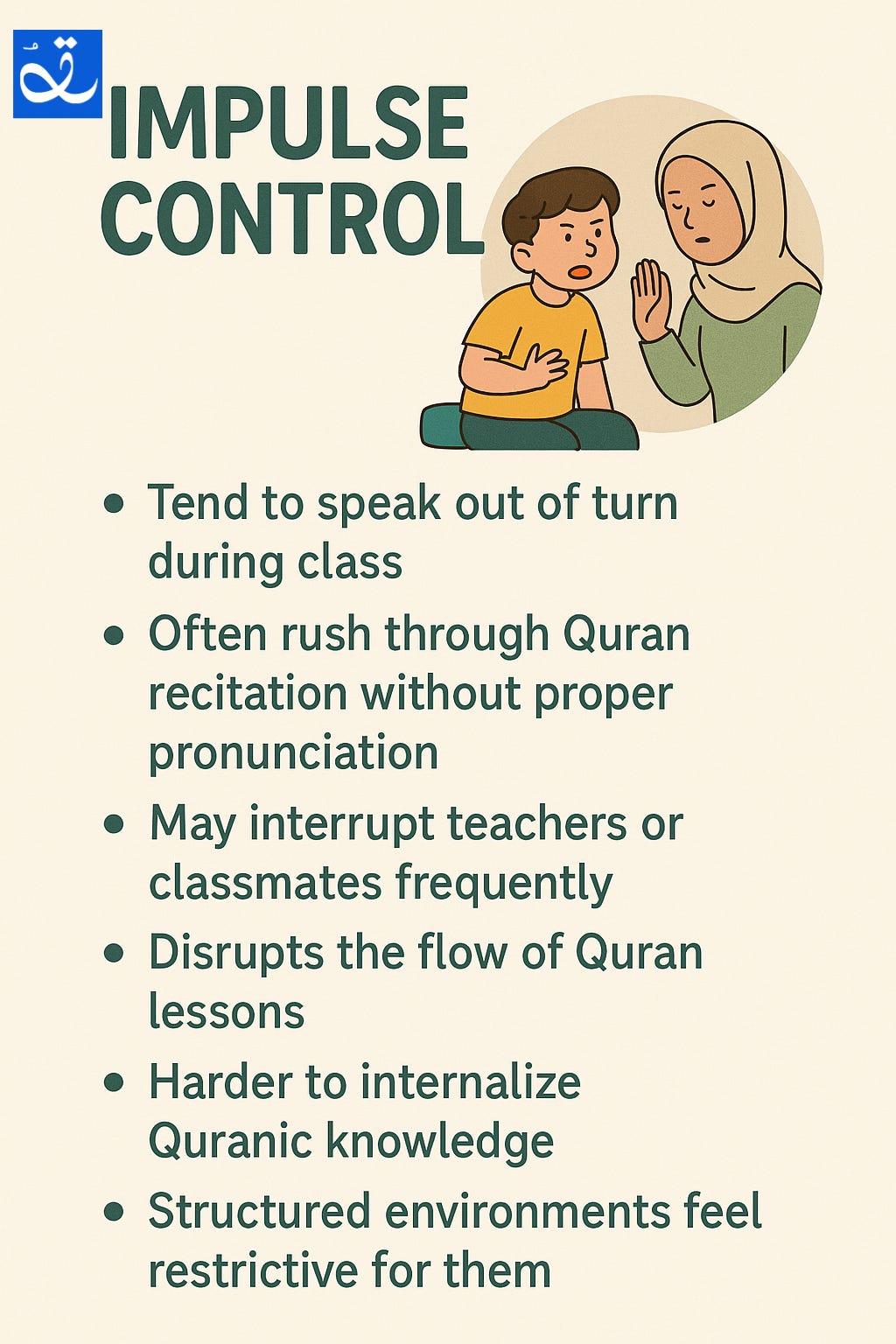
Impulse Control:
Children with ADHD often struggle with impulse control, which can show up in several ways during Quran learning. They may speak out of turn, interrupt the teacher, or rush through their recitation without paying attention to pronunciation or tajweed. These actions aren't intentional disruptions—they’re signs of difficulty in regulating spontaneous reactions.
Such behaviors can break the flow of the lesson and affect group learning. They also prevent the child from fully focusing and internalizing the Quran, as their mind is often racing ahead of the task at hand.
In highly structured Quran classes, where students are expected to wait patiently, follow rules, and recite calmly, these children may feel restless or restricted. Without the right support, this can lead to frustration and withdrawal from learning altogether.
Recognizing these patterns helps parents and teachers create a more flexible, understanding environment that supports both discipline and the child’s unique learning needs.
Strategies for Enhancing Quran Learning
To support children with ADHD in their Quranic studies, consider implementing the following strategies, each designed to accommodate their unique learning needs and help them thrive both spiritually and cognitively:
1. Movement-Based Learning
Children with ADHD often exhibit high levels of physical energy, which, if not appropriately channeled, can interfere with their ability to focus on traditional learning tasks. Movement-based learning strategically incorporates physical activity into the educational process, providing a dynamic outlet for this energy while reinforcing cognitive engagement. Rather than expecting stillness as a prerequisite for learning, this approach accepts movement as an essential part of the child’s learning style.
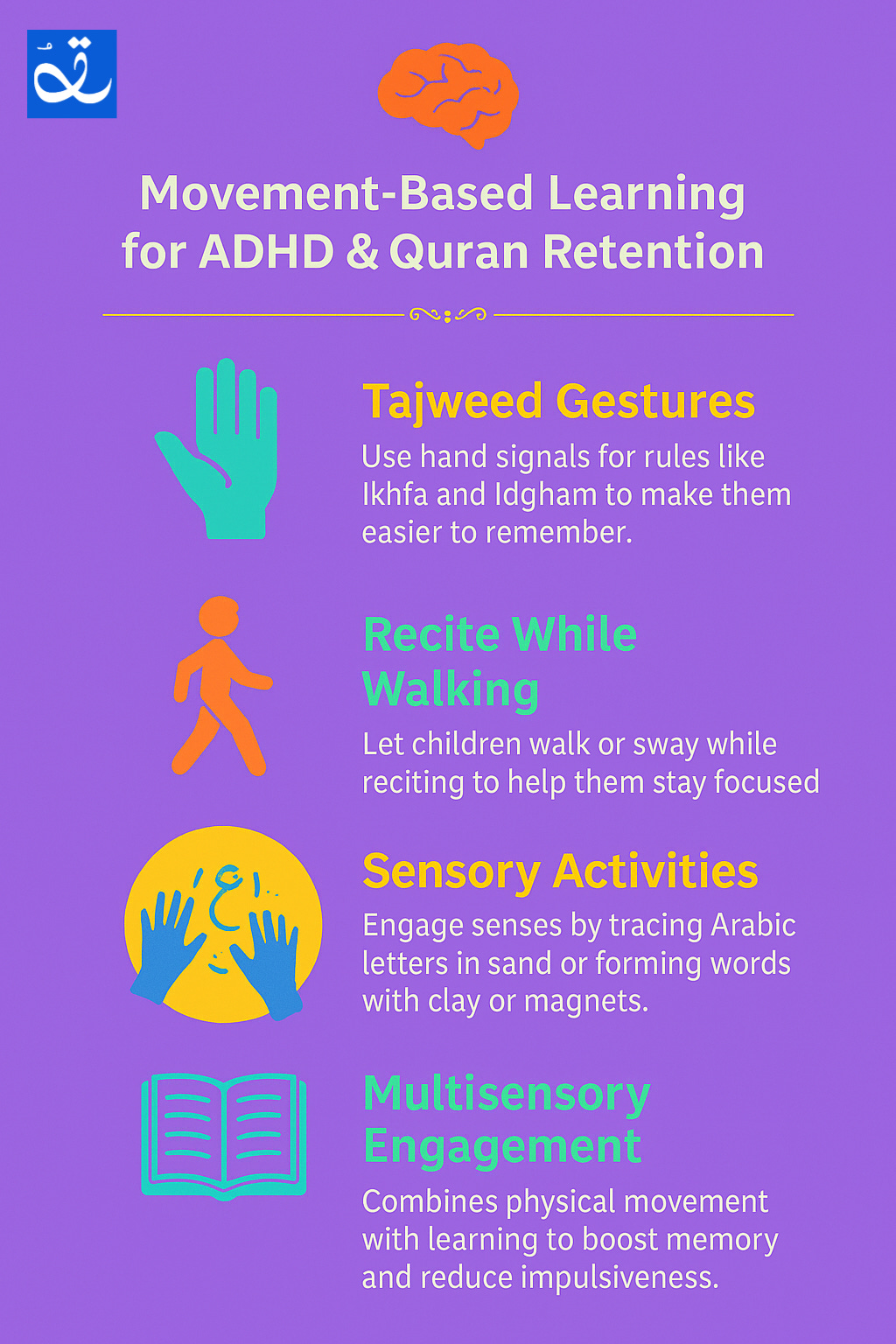
a. Gestures for Tajweed Rules
Many Tajweed concepts—such as Ikhfa, Idgham, or Qalqalah—can be abstract and difficult for young learners to grasp. By assigning specific hand gestures or body movements to these rules, children can associate each abstract rule with a concrete physical action. For example, a sweeping hand motion might represent Idgham, symbolizing the merging of sounds. This kinesthetic reinforcement helps solidify memorization and understanding by linking movement with meaning.
b. Walking While Reciting
Instead of insisting on seated, motionless recitation, children with ADHD may benefit from being allowed to walk, pace, or sway gently while reciting verses. This physical movement can help regulate their attention and reduce the urge to fidget or become distracted. Pacing engages the body rhythmically, which in turn can support rhythmic recitation and sustained vocalization.
c. Interactive and Sensory-Based Activities
Activities such as tracing Arabic letters in sand, shaping them using clay, or forming words with magnetic letters can engage multiple sensory channels—visual, tactile, and kinesthetic. These activities not only reinforce letter recognition and phonetic patterns but also transform Quran learning into a full-body experience, which can be especially beneficial for neurodiverse learners.
Research supports the efficacy of movement-based learning, especially for children with ADHD. Studies have shown that integrating physical activity into instructional routines enhances concentration, working memory, and behavioral inhibition. By incorporating movement, children are more likely to stay engaged and retain information effectively [4].
2. Time Management Techniques
Implementing structured time management methods can help maintain attention, reduce cognitive overload, and prevent burnout during Quran learning. These techniques are particularly helpful for children who may struggle with focus or sustained mental effort. When applied consistently, they can foster a more productive and enjoyable learning experience.
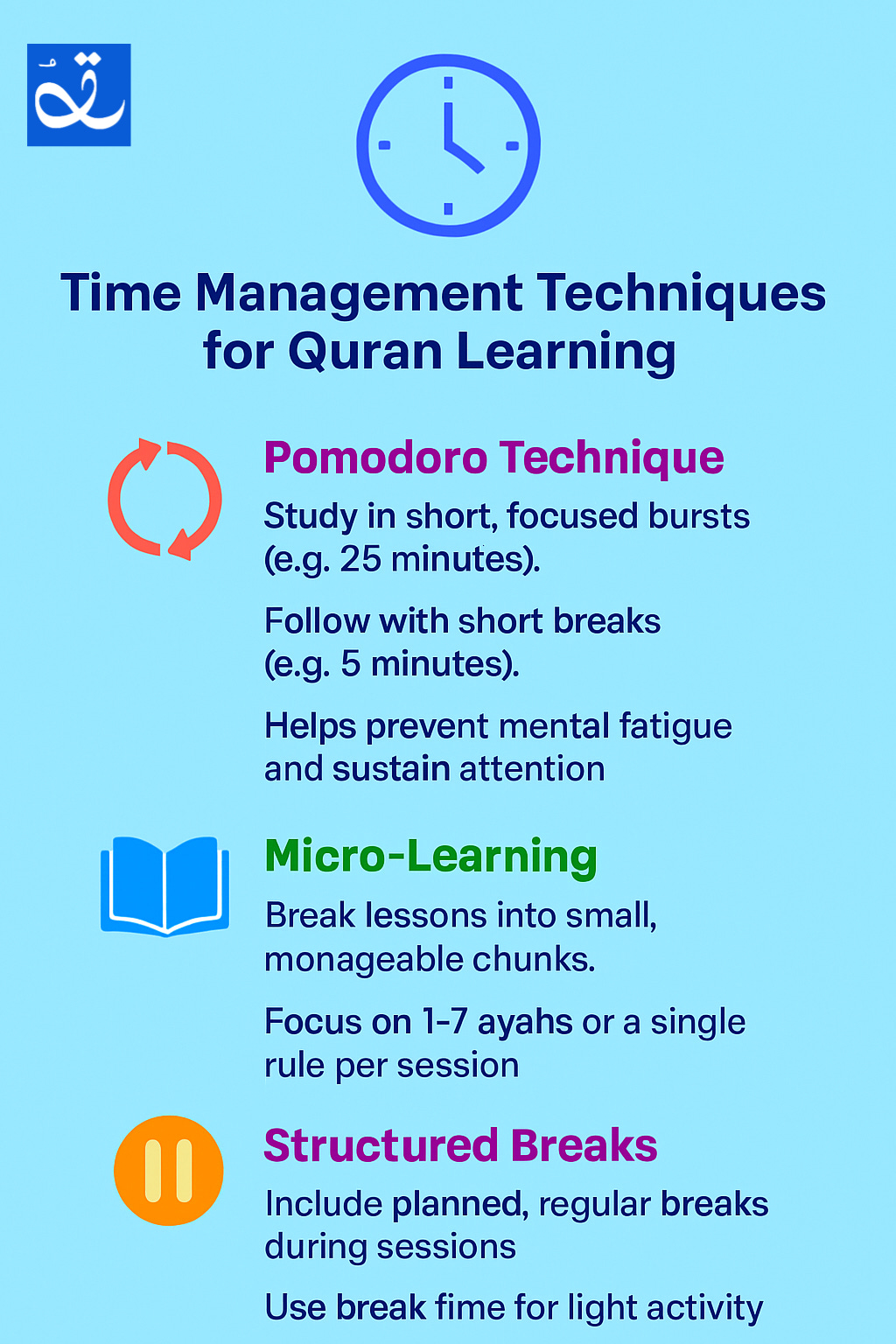
Pomodoro Technique
The Pomodoro Technique is a time management strategy that divides work into focused intervals—traditionally 25 minutes of study or task time—followed by short breaks of about 5 minutes. This cycle is repeated four times, after which a longer break (15–30 minutes) is taken. The key benefit of this approach is its ability to maintain high levels of attention without leading to mental fatigue. For Quran learning, this technique can be adapted to suit the child’s developmental stage. For instance, younger children might start with 10- or 15-minute focus intervals followed by a 3- to 5-minute break. This system creates a rhythm that balances concentration and rest, helping to prevent cognitive burnout while encouraging consistent progress [5].
Micro-Learning
Micro-learning involves breaking down lessons into smaller, easily digestible chunks. Instead of tackling a long surah or a large portion of Tajweed rules in one session, the material is divided into small segments that can be covered in a few minutes. This method respects the natural limits of a child’s attention span and reduces the overwhelm associated with large learning tasks. For example, a lesson might focus solely on mastering one Tajweed rule or memorizing two ayahs instead of an entire ruku. By achieving small goals more frequently, learners gain confidence and a sense of accomplishment, which reinforces motivation and retention.
Structured Breaks
Incorporating planned, structured breaks into the study schedule allows children to rest their brains and refresh their energy. These breaks are not just time away from learning but are deliberately timed and used for activities that enhance mental clarity. Breaks might include stretching, a few minutes of light physical activity, hydration, or even deep breathing exercises. Regular breaks help reduce restlessness, especially for children who are kinesthetic learners or have high physical energy. Scheduled pauses also help reset attention, so children return to their Quran studies with renewed focus and reduced frustration.
3. Tools to Enhance Focus
Children with ADHD often thrive in structured environments that provide clear expectations, immediate feedback, and engaging, sensory-rich learning experiences. Introducing purposeful tools into their Quran learning routine can significantly enhance their ability to focus and retain information. Here are three practical tools backed by research:
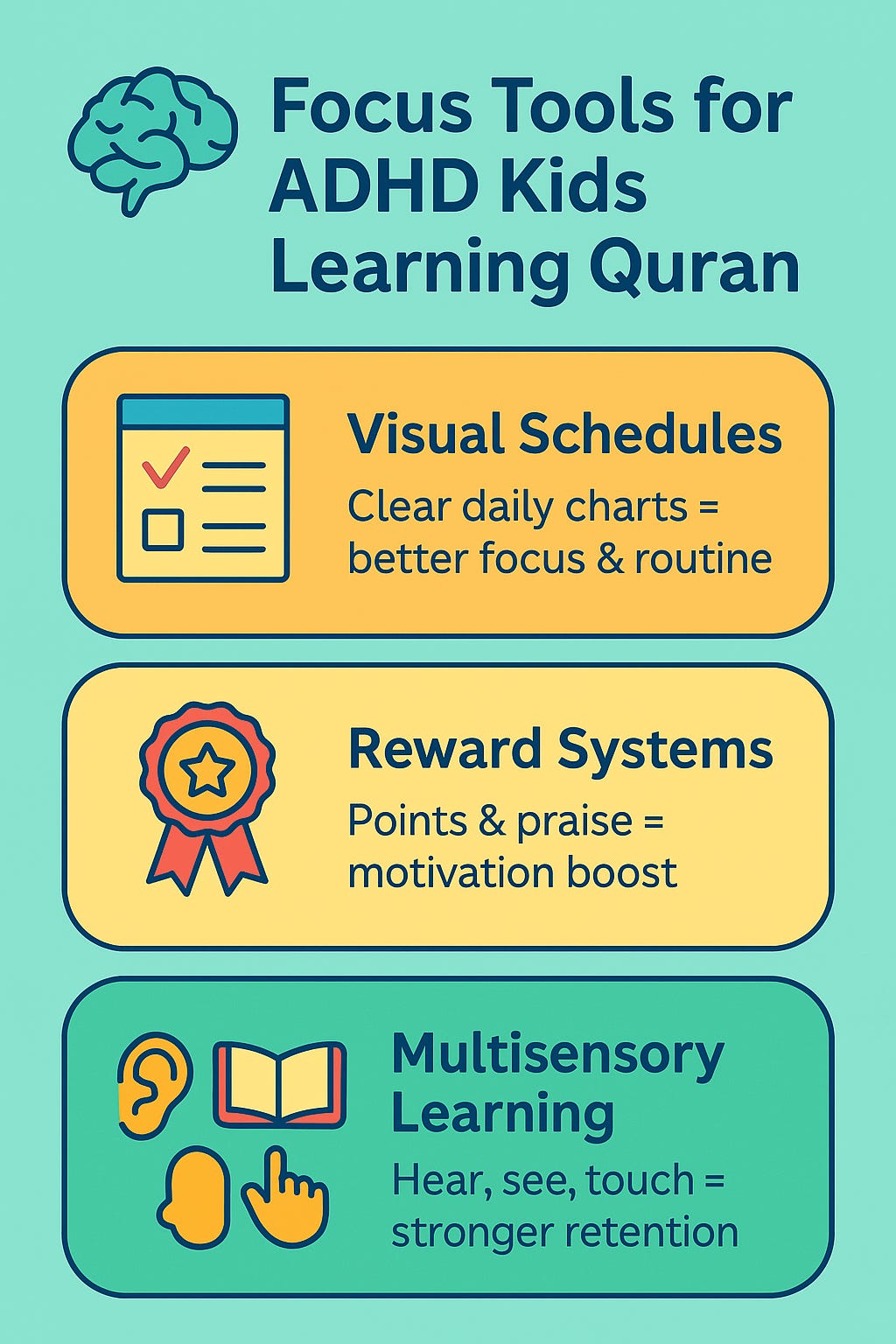
Visual Schedules
Children with ADHD benefit greatly from visual structure. A visual schedule—a chart or board that outlines the day’s tasks—can offer predictability and reduce anxiety about what’s coming next. For Quran learning, this might include segments such as warm-up dhikr, listening to recitation, reading practice, and review. Visual cues help children understand the flow of the session and stay on task. Research shows that visual schedules are effective in improving on-task behavior and reducing disruptive episodes among children with ADHD [6].
Reward Systems
Immediate positive reinforcement plays a crucial role in motivating children with attention difficulties. By implementing a point-based reward system or token economy, children can earn tangible or intangible rewards (like a sticker, a favorite activity, or words of praise) upon completing a task. These systems work especially well in Quranic learning sessions when tied to specific goals, such as finishing a verse or reciting with proper Tajweed. Studies indicate that reward systems can help improve cognitive deficits in children with ADHD by enhancing the brain’s processing of relevant stimuli and increasing sensitivity to errors [7]. This not only motivates learning but also reinforces correct recitation and focus.
Multisensory Learning
Children with ADHD often benefit from engaging multiple senses simultaneously. Multisensory learning—where visual, auditory, and tactile inputs are integrated—can help maintain their attention and improve memory retention. In the context of Quranic learning, this might include listening to a recitation while reading along visually and tracing the Arabic script with a finger. Such techniques reinforce neural pathways through repeated sensory input. Educational research has found multisensory instruction to be particularly effective in helping children with ADHD absorb and retain information more effectively [8].
By integrating these tools—structured visuals, motivational rewards, and sensory-rich methods—parents and educators can create a Quran learning environment that not only supports attention but also nurtures joy and a sense of achievement in children with ADHD.
Parental Guidance: Patience and Motivation
Parenting a child with ADHD is an ongoing journey requiring extraordinary patience, deep empathy, and consistent encouragement. Often, behaviors linked to ADHD, such as impulsivity, hyperactivity, or inattentiveness, can lead to misunderstandings or frustration, both for parents and children. Approaching these challenges with patience creates a nurturing environment that fosters emotional, educational, and spiritual growth.
Recognizing and celebrating even the smallest achievements is crucial for building your child's self-esteem. Praise their efforts, not just the outcomes, reinforcing the value of persistence and dedication. Celebrate when your child successfully maintains focus during Quran sessions, memorizes even a small verse, or shows improved patience during prayer times. Though seemingly minor, these moments become powerful motivators and help establish positive behavioral patterns.
Establishing and maintaining a structured routine significantly supports your child's progress. Children with ADHD thrive in environments that are predictable, clear, and consistent, reducing anxiety and improving their ability to concentrate. Create specific daily schedules for Quran reading, prayers, playtime, and rest, enabling your child to internalize these routines gradually and comfortably.
Open, honest, and empathetic communication plays a critical role as well. Regularly engage your child in discussions about their feelings, struggles, and achievements. Validating their emotions and experiences provides emotional security and encourages them to share openly. Active listening and calm, understanding responses reinforce your bond and support their emotional development.
Additionally, never hesitate to seek professional guidance from therapists, educators, or counselors specializing in ADHD. These experts can provide tailored strategies to enhance your child's learning abilities, self-regulation, and overall well-being, making your parenting journey more effective and less stressful.
Above all, your unwavering belief in your child's potential is transformative. Your continuous encouragement, love, and support offer a solid foundation for their spiritual, educational, and emotional journey, empowering them to thrive despite challenges.
📅 Next Thursday, we'll dive into another intriguing aspect of Quran education: Teaching Quran to Dyslexic Learners—Breaking the Reading Barrier. Join us to explore innovative strategies that empower dyslexic children to overcome reading challenges and confidently build their connection with the Quran.
📚 References
Thomas, R., Sanders, S., Doust, J., Beller, E., & Glasziou, P. (2015). Prevalence of attention-deficit/hyperactivity disorder: A systematic review and meta-analysis. Pediatrics, 135(4), e994–e1001.
Centers for Disease Control and Prevention (CDC). (2022). Data and Statistics About ADHD. Retrieved from
Scott, N., et al. (2022). Multisensory Enhancement of Cognitive Control over Working Memory in Children with ADHD. ResearchGate.
Kinems. (2020). How Movement-Based Learning Enhances Concentration and Inhibition of Impulsivity of Children with ADHD.
Mental Health Center Kids. (2022). Pomodoro Technique for ADHD.
Sargsyan, Z., et al. (2021). Visual Schedules as a Tool to Improve On-Task Behavior in Children with ADHD. Psychiatry Journal, Article ID 8733412.
Ma, I., van Duijvenvoorde, A. C. K., Scheres, A. (2013). The interaction between reinforcement and inhibitory control in ADHD: A review and research agenda. Journal of Child Psychology and Psychiatry, 54(6), 581–594.
ADHD Foundation. (2022). Using Multi-Sensory Approaches for Children with ADHD.