

Introduction: Quran for All Learners
“And We have certainly made the Quran easy for remembrance”
This verse from the Quran (54:17) reminds us that the Holy Quran is meant to be accessible to everyone [5].
Yet for children and adults with dyslexia, a common reading disability, accessing the Quran’s text can feel daunting. Dyslexia affects an estimated 5–15% of the population [1], impacting reading and spelling skills despite normal intelligence and education.
Breaking the Reading Barrier
This article explores how we can break the reading barrier for dyslexic learners, ensuring they too can connect with the words of Allah. We will:
Define dyslexia and its types
Understand the challenges dyslexic students face in reading Arabic script
Present practical strategies—drawing on modern educational research and Islamic teaching methods—to make Quran learning friendly and achievable
Empowering Every Learner
The goal is simple: to empower Muslim parents, teachers, and learners with the knowledge and tools they need so that no one is left behind in reading and loving the Quran.
Understanding Dyslexia
What Is Dyslexia?
Dyslexia is a specific learning disability that is neurobiological in origin [2]. In simple terms, the brains of people with dyslexia process written language differently, which makes reading unexpectedly difficult compared to their intelligence and educational background.
Dyslexia is characterized by:
Difficulties with accurate and/or fluent word recognition
Poor spelling and decoding abilities [2]
At the core of these challenges is often phonological processing—the ability to identify and manipulate the sounds in language. In fact, phonological deficits are considered a hallmark of dyslexia [3].
It’s crucial to understand that dyslexia does not indicate low intelligence or laziness. Rather, it means the brain learns differently and needs a specialized approach. Many successful individuals—like Thomas Edison and Richard Branson—were dyslexic, proving that with the right support, dyslexic people can thrive.
Symptoms and Early Signs
Symptoms of dyslexia typically appear in early childhood. Some common signs include:
Difficulty learning the alphabet or new words
Mixing up similar-looking letters (e.g., b vs d)
Trouble with rhyming or breaking words into sounds
Reading below age level
Avoiding reading aloud [4]
Other indicators:
Inconsistent spelling, such as spelling the same word differently on one page
Writing with poor structure or grammar
Inverting letters or syllables when reading (e.g., reading Quran as Ruqan)
Fatigue or headaches from reading
Frustration with school, low self-esteem, or acting out to avoid reading tasks [4]
Importantly, dyslexia presents differently in each person. It exists on a continuum from mild to severe [3]. For instance:
One learner might struggle with slow, effortful reading
Another may read quickly but with poor accuracy or comprehension

Types of Dyslexia
Researchers and educators have identified several subtypes of dyslexia, which help guide targeted interventions [4].
1. Phonological Dyslexia
The most common type
Involves difficulty processing phonemes (language sounds)
Affects a student’s ability to map letters to sounds
Makes it hard to sound out Arabic words or apply tajweed rules
2. Surface (Visual or Orthographic) Dyslexia
Struggles with recognizing whole words by sight
May depend heavily on phonics, yet fail to recognize common words instantly
3. Rapid Naming Deficit
Involves difficulty quickly retrieving names for letters, numbers, or words
Slows down the reading of Arabic letter names or Quranic vocabulary
4. Double-Deficit Dyslexia
A combination of phonological and naming-speed deficits [4]
Often considered the most severe form
These types often overlap, but they underscore a critical point: dyslexia can affect both the sound-based and visual recognition aspects of reading.
The Power of Early Support
Regardless of the type, early identification and the use of a structured, multisensory teaching approach can significantly improve a dyslexic child’s ability to read [4]. With the right strategies and patience, Quran learning becomes not only possible but also empowering.
Challenges Dyslexic Learners Face in Quran Reading and Memorization
Teaching Quranic Arabic to a dyslexic learner requires understanding the unique obstacles they face. Many challenges are similar to those encountered when dyslexic students learn any new language, but some are specific to the Arabic script and Quranic context.
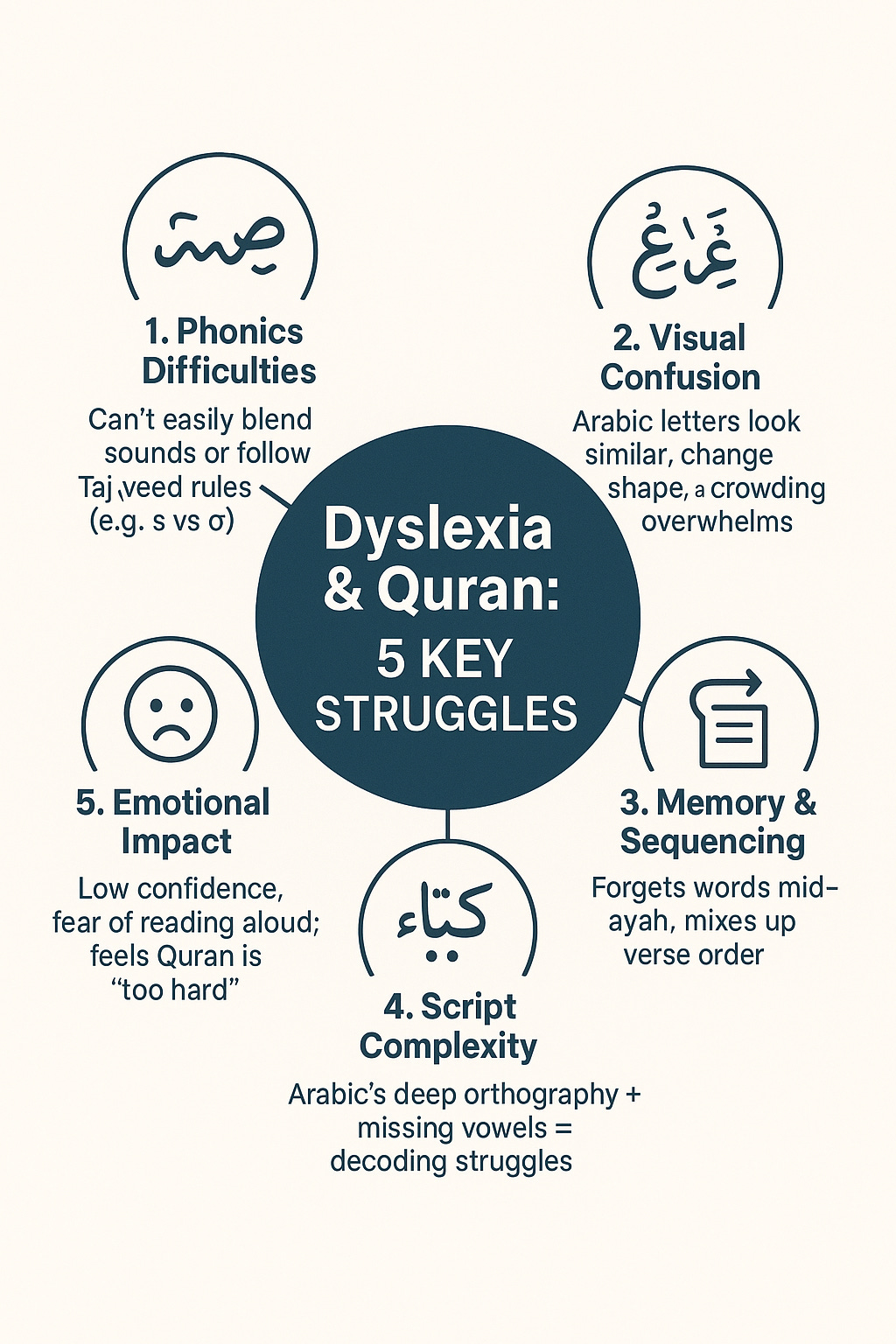
Phonological Processing and Tajweed:
Quranic Arabic has a rich sound system with emphatic letters, elongated vowels, and subtle pronunciation rules (tajweed). Dyslexic learners often have difficulty phonemic awareness – distinguishing and manipulating sounds. They may struggle to hear the difference between similar sounds like س (s) vs ص (ṣ), or to remember the sequence of sounds in a long word. Blending sounds into a word is hard for them [1]. For example, a dyslexic child might slowly sound out “Bismillah” as “B…i…s…m…i…l…l…a…h” and then be unable to consistently blend it into the complete word. Tajweed rules can add complexity; a rule like idgham (merging sounds) or recognizing the subtle qalqalah echo might overwhelm a student who is already focusing intensely on basic decoding. Memorization vs. reading can also diverge: some dyslexic children have excellent auditory memories and can memorize short surahs by ear, but without strong decoding skills they might recite from memory rather than actually read the Arabic text. This means they may appear to read fluently from the Mushaf, when in reality they have memorized the page – a fact that becomes apparent when they encounter an unfamiliar passage.
Visual Processing and Arabic Script:
The Arabic writing system poses distinct visual challenges. Letters in Arabic are written in a cursive (joined) form, and many letters change shape depending on whether they appear at the beginning, middle, or end of a word. For instance, the letter ع looks very different in isolation versus in the middle of a word. This shape-shifting nature of Arabic letters can be confusing for dyslexic learners [10]. It may feel like they have to learn multiple “faces” of each letter. Moreover, several Arabic letters have only tiny differences between them – often just the placement of a dot or two. A dyslexic child could easily mix up letters like ب/ت/ث or ج/ح/خ, which have similar base shapes. They might also struggle with letters that look like mirror-images or rotations of each other. For example, the letters د and ذ are identical except for a dot, as are ر and ز; a letter like م has a looping shape that might be confused with لا at first glance, and so on. Visual crowding is another issue: traditional Quran copies are often printed in elaborate calligraphy with many intricate diacritical marks (vowel signs, madd, sukoon, etc.) densely packed around each word. For someone with dyslexia, this can be visually overwhelming – the letters and symbols may seem to “swim” on the page or jumble together. One dyslexic reader described it as seeing text “without spaces, letters formed backwards or words broken up,” giving an example: “I tisv er yd ifficu ltf or meto re adthi s” (scrambled for “It is very difficult for me to read this.”) [7]. This illustrates how disorienting a block of text can be. In the Quranic script, although the letters are beautifully written, a dyslexic learner might lose their place easily or misread a word like قل (“qul”) as لق by swapping letters around. Such errors are not due to carelessness – they stem from the way the dyslexic brain processes visual input.
Working Memory and Sequencing:
Dyslexia often comes with challenges in working memory and processing speed [3]. This means a dyslexic student may take longer to decode a word and meanwhile could forget what the earlier part of the verse was. Reciting a full ayah from the Quran requires keeping a sequence of Arabic words (and their sounds) in memory. A dyslexic child might read one word at a time slowly, and by the time they reach the third or fourth word, the meaning or the exact pronunciation of the first word might have slipped away, causing them to start over repeatedly. This can make long verses especially difficult and discouraging. Additionally, Quran memorization relies on repetition and sequence; a learner with dyslexia might mix up the order of verses or skip a line without realizing, because their brain might not send a strong signal that something is out of sequence.
Arabic-Specific Reading Pains:
Research indicates that the transparency of a language’s orthography (how consistently letters map to sounds) affects dyslexic readers [1]. Arabic is an example of a deep orthography: outside of the fully vowelled Quranic text, written Arabic usually omits short vowels, making decoding heavily context-dependent. Even in the Quran, where vowels are included, the presence of many similar-looking letters and the cursive script means Arabic reading isn’t as straightforward as, say, reading Spanish. It’s no surprise that a study in Malaysia found that about 79% of children with dyslexia had difficulty reading Quranic verses[1]. When tested on basic Quran primers (Iqra’ reading series), over half of those dyslexic students could not even recognize all the individual Arabic letters, and none of them could read an elementary Quranic word unaided[1]. This highlights that without special intervention, the Hijaiyyah (Arabic alphabet) itself can be a major hurdle. Simply putting a dyslexic child in a standard Quran class and urging them to “practice more” is usually not effective; their brain requires a different teaching approach.
All these challenges can affect the child’s confidence and motivation. They may start to feel that the Quran is “too hard” for them or feel ashamed when they misread in front of peers. Frustration and anxiety can set in – one dyslexic student shared that he was “on the verge of tears… thinking how I don’t want learning Quran to be impossible for me” (as reported on a forum). Recognizing these hurdles is the first step. The next step is to adapt our teaching to help dyslexic learners overcome them, one careful step at a time.
Historical and Cultural Perspectives on Dyslexia in Islamic Education
Classical Understanding of Reading Difficulties
Historically, the term “dyslexia” did not exist in classical Islamic scholarship—it is a modern term coined in the late 19th century. In traditional maktabs and madrasas, children who struggled to read the Quran were often seen as "slow" or "weak" learners. They were usually urged to practice more or were scolded for making mistakes, with little understanding that a neurological difference might be the cause. Many dyslexic Muslims likely felt misunderstood, labeled lazy or inattentive, despite trying hard.
Emphasis on Mercy and Individualized Learning in Islam
Despite the lack of a clinical term, Islamic tradition strongly values mercy, patience, and tailoring learning to individuals. The Prophet Muhammad (pbuh) emphasized kindness to learners and said, "Seek knowledge from the cradle to the grave." Importantly, he himself was described as "ummi"—unlettered—and received the Quran orally from Angel Jibreel, repeating it until it was memorized. Many companions also learned the Quran by ear before it was ever written down [7].
This tradition validates oral learning as a foundational method. Dyslexic learners, who struggle with visual decoding, can still learn effectively through listening and repetition, following the same pattern as the Prophet and his companions.
Modern-Day Awareness and Shifts
Today, many Muslim communities are becoming more aware of learning disabilities. Countries like Malaysia and Egypt are conducting studies on dyslexia and Quran learning [1]. Workshops and training programs are increasingly equipping Quran teachers with inclusive teaching strategies.
Culturally, there is a noticeable shift from “the child is lazy” to “the child learns differently.” Parents are seeking evaluations rather than merely adding tutoring hours. Teachers are adjusting instruction—giving more time, simplifying tasks, or offering oral alternatives for students with dyslexia.
Islamic Principles Encouraging Inclusion
The Quran says, "Allah does not burden a soul beyond that it can bear" (Quran 2:286) [5], encouraging flexibility and compassion. In Shariah, people with difficulties are given accommodations—like praying seated if standing is too hard. Similarly, a child struggling to read Arabic text can rely on listening, assistive tools, or slower pacing without guilt.
Islam also commands compassion for all. A hadith says: "Show mercy to those on earth, and the One above the heavens will show mercy to you." That includes mercy in education. Historical examples exist, like teaching Islam through sign language to a deaf companion, or accommodating blind individuals. Supporting dyslexic learners aligns with these core values.
Reframing Dyslexia Through an Islamic Lens
Contemporary scholars and educators are reframing dyslexia not as a flaw, but as a test—and an opportunity for reward and growth. One scholar compared today’s dyslexic learners to the Prophet (pbuh) in his unlettered state—neither should be stigmatized; both simply need oral and accessible methods.
In short, while dyslexia as a clinical term is new, Islam’s spirit of inclusion, oral learning, and compassion provides a powerful foundation for dyslexic-friendly Quran education.
Modern Strategies, Tools, and Technologies to Support Dyslexic Students in Quran Learning
Thankfully, today we have a much better understanding of how to teach children with dyslexia – and these insights can be directly applied to Quranic education. By using modern multi-sensory strategies and assistive technologies, we can significantly improve the Quran learning experience for dyslexic learners. Below are some effective approaches, each supported by educational research and real-life classroom success stories:
1. Structured Phonics and the Noorani Qaida Method
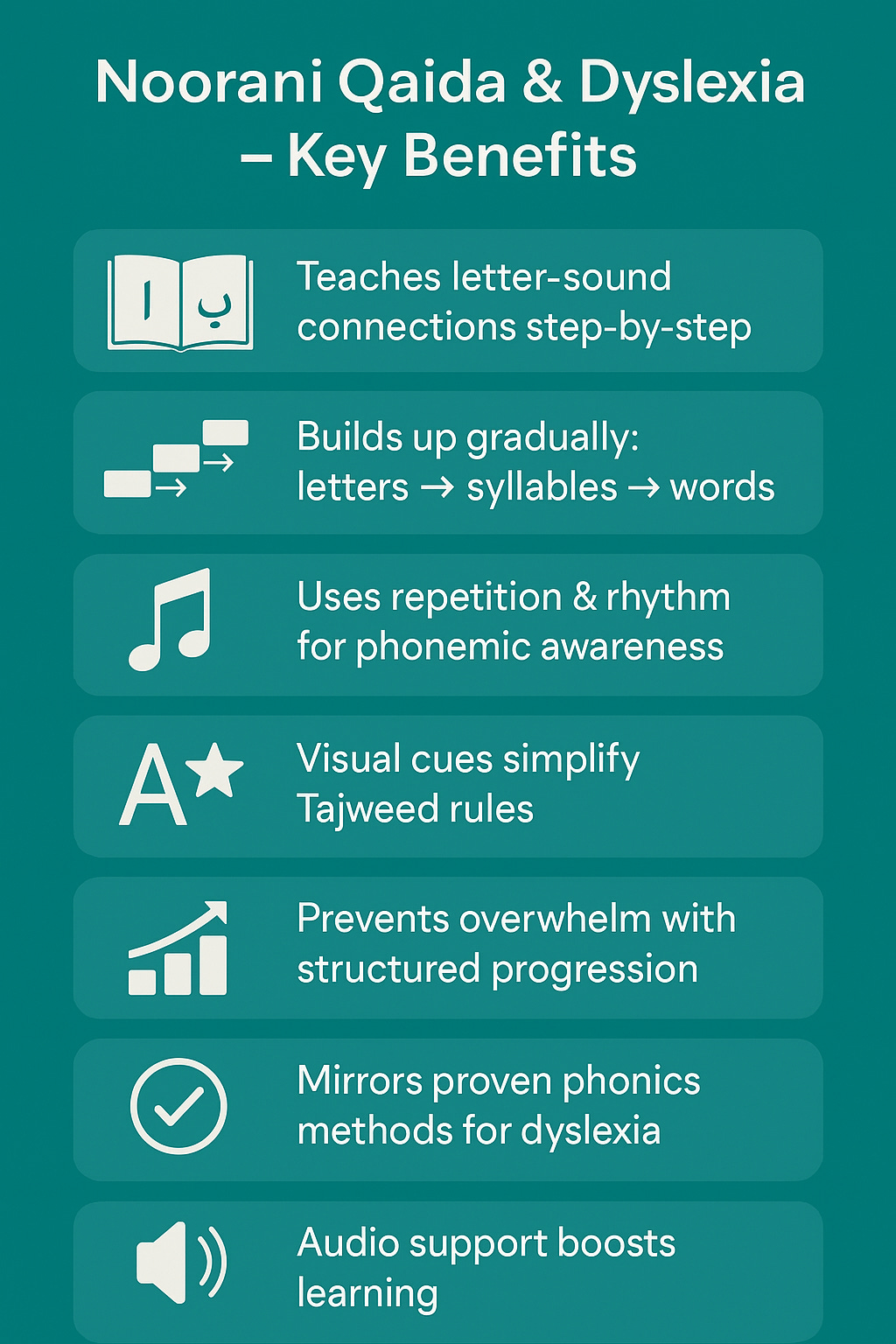
One of the most powerful interventions for dyslexia is a structured phonics approach, which explicitly teaches the link between letters and sounds. In the English-speaking world, methods like Orton–Gillingham and Wilson Reading System are well-known phonics-based curricula for dyslexic students. In Quranic education, we have an analogous tool in the Noorani Qaida, a beginner’s booklet that systematically teaches the Arabic letters, their vowel sounds, and basic tajweed step-by-step [5].
How Noorani Qaida helps: It starts from the very basics – recognizing each Arabic letter in isolation with its correct pronunciation – and then gradually builds up. First, the student masters the letters (alif, ba, ta, etc.), then the harakat (vowel marks like fatha, kasra, damma), then reading simple syllables, and later whole words and sentences from the Quran. This incremental progression ensures the dyslexic learner isn’t overwhelmed [5]. Each lesson builds on the previous one in a logical way. For example, once the student learns the letters and short vowels, Noorani Qaida introduces how those combine to form a consonant-vowel syllable (like بِ = bi, مَ = ma), then two-syllable words, and so on [5]. This mirrors the best practice in dyslexia instruction: start simple and increase complexity in small, manageable steps.
Crucially, Noorani Qaida and similar Quran primers emphasize phonetic awareness – the student voices every letter and vowel sound, often in a chant-like rhythm, which reinforces the sound-letter connection [5]. Research shows phonics-based instruction is highly effective for individuals with dyslexia[5]. A dyslexic child might not intuitively pick up sound patterns just by exposure, so explicitly teaching “this letter makes this sound” and practicing it repeatedly fills that gap. For instance, they will practice that م sounds /m/, ما sounds maa, مو sounds moo, etc., until these become more automatic. One parent of a dyslexic child reported that using a phonics-based Quran primer “unlocked” their child’s ability to decode – what previously looked like random squiggles started to make sense as letters that form words.
Tajweed rules (rules of pronunciation and recitation) are introduced gently at a basic level in such primers, often with visual cues. For example, rules like nasal sounds (ikhfa) or merged sounds (idgham) might be taught with colored letters or simple markings in the text to remind the reader. Noorani Qaida integrates simple tajweed gradually so the student isn’t hit with all the rules at once [5]. This prevents the common issue of a dyslexic student becoming overwhelmed by complex rules before they even grasp basic reading [5].
In practice, many Quran teachers have found success by using Noorani Qaida or similar phonics textbooks with their dyslexic students instead of (or before) jumping to the standard Quran mushaf. There are even digital versions of these Qaida lessons now, with audio, so a child can hear the correct sounds and repeat along. Structured phonics gives a dyslexic learner a strong foundation in the sounds of Arabic, addressing the phonological core of dyslexia.
2. Multisensory Learning Techniques
Dyslexic brains benefit greatly from multisensory input, meaning learning that engages multiple senses (sight, hearing, touch, even movement) simultaneously[5]. Rather than just seeing a letter on a page and trying to remember it, the student might see it, say it, trace it, and hear it all at once. This reinforces neural connections by using different pathways. In Quran learning, there are lots of creative ways to do this:
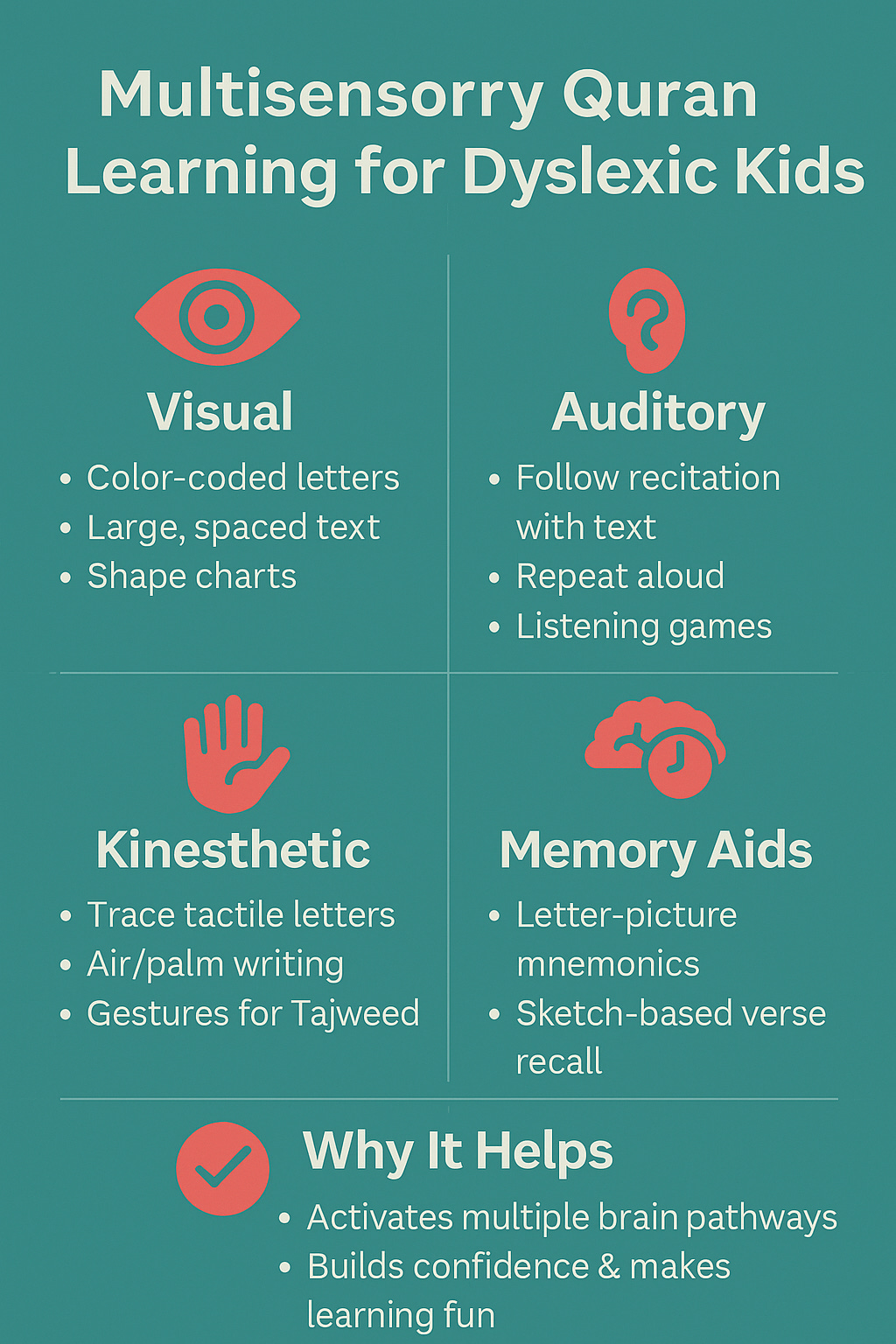
Visual Aids: Use color and big, clear text. Many teachers create custom flashcards for Arabic letters where each letter is boldly printed. For dyslexic children, larger print and extra spacing between letters can significantly improve readability [5]. For example, instead of a cramped line of text, show one word at a time in a font that has clear distinctions (some educators even use specialized fonts – see next section on fonts). Color-coding is a proven technique: you might print all the letters that look similar in different colors (maybe make ب blue, ت red, ث green, etc.) to help the child’s visual memory. One Quran teacher shared that her dyslexic student kept confusing و and ف, so she highlighted all the و’s in verses with a yellow background – this simple visual cue helped the student pay extra attention and differentiate those letters. Additionally, charts that show letters in their initial/medial/final forms in different colors can help untangle the shape variations [10].
Auditory: Leverage the rich oral tradition of Quran learning. Have the student listen to recitations while following along in the text. Many Quran apps or websites provide synchronized audio with text, where each word lights up as it’s recited – this can train the child to match the sounds they hear with the words on the page [10]. Encourage the learner to repeat aloud frequently. If a child misreads a word, instead of just pointing it out, the teacher can clearly pronounce it and have the child repeat it, then read it again in context. There are also auditory memory games: for instance, the teacher reads out three words and asks the child to pick which one is on the page (training listening and word recognition). Given that dyslexic learners often have strong understanding through hearing, tying the visual text to their robust auditory skills is key.
Kinesthetic (Touch and Movement): Involving the sense of touch or motion can create additional memory hooks. One popular method is using tactile letters: cut-out or sandpaper letters of the Arabic alphabet. The student can trace the shape of an ا or ب with their finger while saying its sound. This “muscle memory” of the shape helps reinforce letter recognition. Some teachers use finger-writing in the air or on the student’s palm – for example, saying “write seen in the air” and the child makes the shape; this can help those who struggle to recall a letter just by sight. There are even Quran learning apps that incorporate writing exercises where kids trace letters on the screen. Another idea is to use physical objects: building letters with play-dough or arranging beads in the outline of a letter. Such activities are fun and engage the child’s sense of touch and creativity. Gestures can also be used for tajweed rules – e.g., a teacher might teach the rule of madd (prolongation) by a hand gesture moving outward to indicate stretching the sound, and the student can mimic that gesture when they see the madd symbol, giving a physical action to pair with the concept of lengthening a vowel.
Mnemonic and Memory Aids: Dyslexic learners often think in pictures, so pairing a letter or word with an image can help. Some educators use mnemonic pictures for Arabic letters (for example, drawing م meem as if it’s a little mama with a pregnant belly to remember it’s m; or ص sad drawn as a saw to remember the “s” sound, etc.). While Arabic letters are more abstract than Latin ones, a bit of creativity can yield helpful associations. Likewise, for Quran memorization, dyslexic learners might benefit from storyboarding a sequence of verses – drawing a small sketch for each verse’s key idea, to create a visual chain of events that help recall the order.
A multisensory approach essentially means teaching to all the pathways: seeing, hearing, doing. The Noorani Qaida method we mentioned is inherently multisensory (the student sees the text, listens to the teacher, and reads aloud with finger-tracking). We can amplify that by adding touch and color. According to one academy, incorporating visual, auditory, and kinesthetic elements makes learning “particularly effective for dyslexic learners”[5]. It engages different parts of the brain, so if one neural pathway is weak, others can compensate. And importantly, it often makes learning more fun! Many dyslexic kids come alive when lessons involve games, arts and crafts, or technology, rather than just a black-and-white page of text.
3. Utilizing Technology: Dyslexia-Friendly Fonts, Apps, and Audio Tools
We live in a time where technology can be a great ally in learning. Several innovations specifically target reading difficulties and can be applied to Quran education:
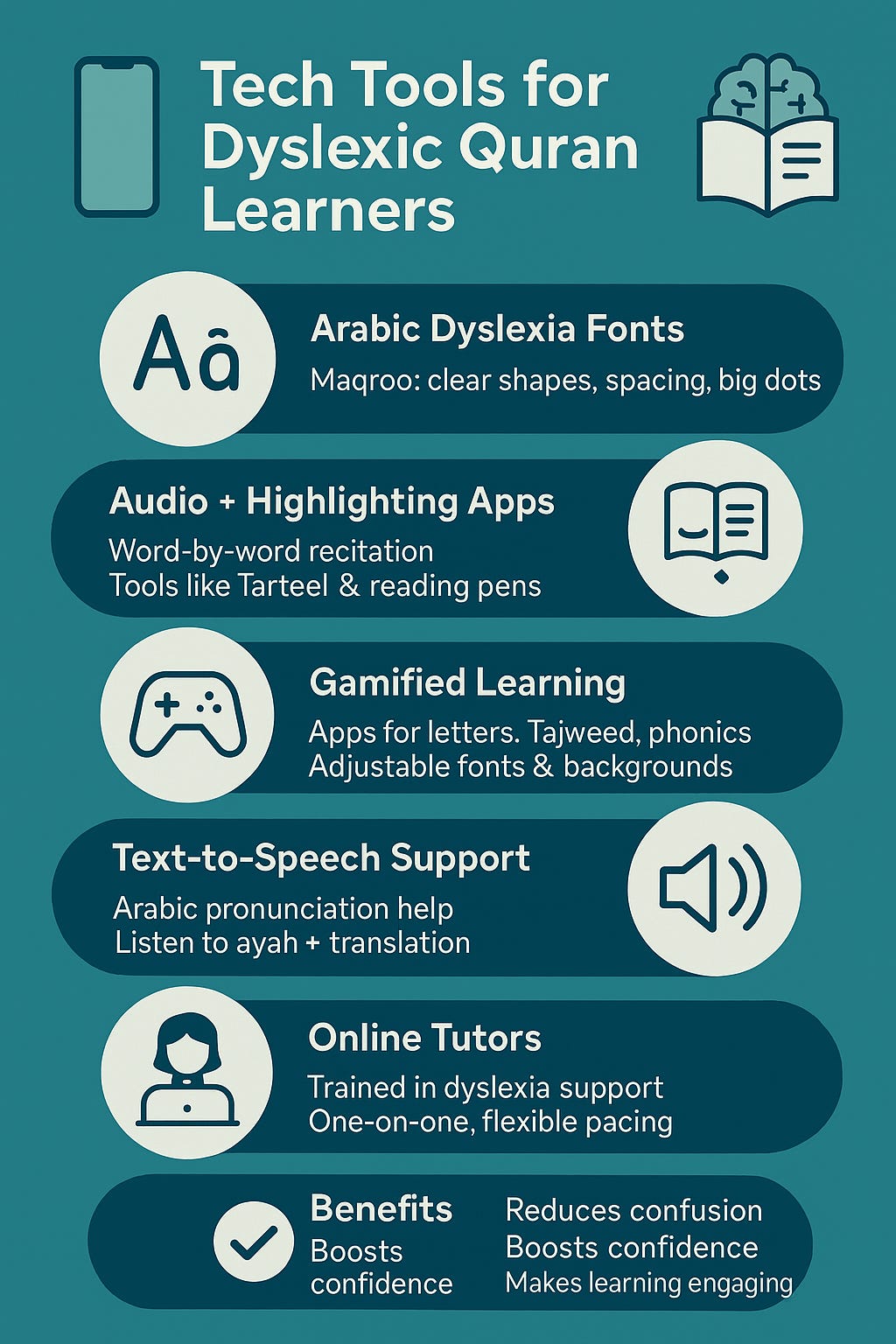
Dyslexia-Friendly Fonts: You may have heard of fonts like “OpenDyslexic” or “Dyslexie” created for English readers with dyslexia – these typefaces have designs that reduce letter confusion (for example, letters are weighted heavier at the bottom to prevent flipping, and each letter has a distinct shape). Until recently, there was no equivalent for Arabic script. However, in 2024 graphic designers in the Middle East introduced “Maqroo”, the first Arabic font tailored for dyslexic readers [9]. Maqroo (meaning “readable” in Arabic) modifies the uniform shapes of traditional Arabic text to make each letter more distinguishable [9]. The designers added slight irregularities: increased spacing between letters, bigger dots and vowel markers, and even alternate shapes for letters when they repeat, so that no two letters look identical in a row [9]. They also eliminated certain ligatures (combined letter forms) that tended to confuse readers [9]. The result is a font where, for instance, a س and ش might have more visual differences, or a ب and ت have dots that are harder to overlook. Early feedback from dyslexic users is positive – it indeed helps reduce some letter mix-ups.
How to use this? If you have access to digital text of the Quran (like an app or Quran software), check if it offers a dyslexic font option. Some Quran learning apps have already begun integrating fonts like OpenDyslexic for their Arabic text. For example, the Tajweed Quran app allows switching to a special font to aid readability [10]. If you’re teaching with printed materials, you might create custom worksheets for your child using a dyslexia-friendly font: there are PDF versions of the Quran in large, simplified Arabic fonts that you could print out. Even just enlarging the text and adding extra spacing (maybe writing one verse per line) can mimic the effect. The idea is to reduce visual confusion by any means – clear typography is one. (See Figure below for a sample of how an adjusted Arabic font looks, with generous spacing and altered letterforms.)
Sample of an Arabic dyslexia-friendly font (“Maqroo”) with irregular letterforms and spacing, designed to improve readability for dyslexic readers[9].
Quran Apps with Audio and Highlighting: There are many apps for Quran study, but a few are especially useful for dyslexic learners. Look for features like word-by-word highlighting (as the reciter reads, each word lights up). Apps such as Quran Majeed, Ayah, or Tanzil on tablets often have this function. By seeing the verses highlighted in sync with audio, a student reinforces their decoding. Another helpful tool is the follow-along laser pointer idea: some digital pens or apps will follow along your recitation and pinpoint where you are on the page. For example, the app Tarteel uses AI: a student recites from memory and the app displays the corresponding verses, filling in as they go, which can be a confidence booster and also catch mistakes. For reading practice, one can use Tarteel in reverse – have the app play an ayah and the student follows along in their mushaf, or the student reads and the app’s voice recognition gently flags if a word was skipped or misread. These tech tools act like a patient tutor available anytime.
Interactive Educational Apps: Beyond straight Quran apps, consider gamified learning apps that teach Quranic Arabic or letters. Apps like “Learn Quran Kids” or “Noorani Qaida” apps present letters and tajweed in game form – e.g. matching games for letters, quizzes with instant feedback, animations demonstrating how letters connect. Many dyslexic children are tech-savvy and find tablet learning less intimidating than a thick book. One dyslexic learner shared that using an iPad app to practice letters felt more like playing and less like “remedial reading class,” which improved her attitude. These apps also often include dyslexia-friendly settings: some allow changing background colors (some dyslexic readers find certain colored overlays reduce glare and help focus), adjusting font size, or turning on a special font as mentioned. Don’t shy away from using English phonetic helpers within the app if needed (some apps have the option to show transliteration under the Arabic – while transliteration isn’t a long-term substitute for actual Arabic reading, it can serve as a scaffold while the student builds decoding skills).
Text-to-Speech and Audiobooks: While we don’t have “audiobooks” of the Quran in a conventional sense (since Quran is recited, not just read aloud as a monotone book), we do have high-quality recordings of the Quran and even explanatory audio. For a dyslexic learner, listening to the meaning translation in their native language (many apps can play an English translation after each Arabic ayah) can help keep comprehension up even if the reading is slow. Additionally, there are text-to-speech tools for Arabic that could, in theory, read out any Arabic text. This means if a child is practicing reading a line and gets stuck, a text-to-speech could pronounce the word for them. Some reading pens available in Islamic bookstores work this way: e.g., the Quran Reading Pen – you point it at a verse and it recites it aloud. Such devices let the learner immediately hear the correct pronunciation without needing a teacher right there. It empowers more independent practice: the child reads as much as they can, and uses the pen for help on words they find difficult. This kind of assistive tech is great for dyslexic kids because it gives them a sense of control and reduces the frustration of getting stuck.
Online Tutoring and Specialized Courses: The internet has also enabled access to teachers who specialize in teaching Quran to children with learning differences. Platforms like Iqra Network, Studio Arabiya, or Resala Academy offer online classes where teachers are trained to be patient and use multisensory methods. Some programs explicitly mention accommodating dyslexia or have experience with it. If local resources are scarce, an online tutor who understands dyslexia can be a game-changer. They might use a webcam and digital whiteboard to do letter exercises or allow the child to type answers if writing is hard. The advantage is the one-on-one pacing and customization: the teacher can slow down or repeat as needed, and the privacy of home can remove any embarrassment the student feels in a group class.
By embracing these modern tools, we align with the Quran’s own ethos of being a guidance that is not meant to be burdensome. In a way, using an app or a special font is akin to using a ramp for someone in a wheelchair – it’s an accommodation that grants access. One mother reported that after switching her dyslexic son to a Quran app with large text and audio, his interest in Quran time skyrocketed; he said it was the first time he could follow along without feeling lost. We should view technology not as a crutch, but as a legitimate aid that can enhance traditional learning. When paired with a caring teacher or parent, tech can reinforce lessons and make practice more engaging.
4. Emotional Support, Encouragement and Adaptation
Teaching a dyslexic learner the Quran is not only about techniques and tools, but also about patience and emotional support. Parents and teachers should foster a positive, growth-oriented environment:
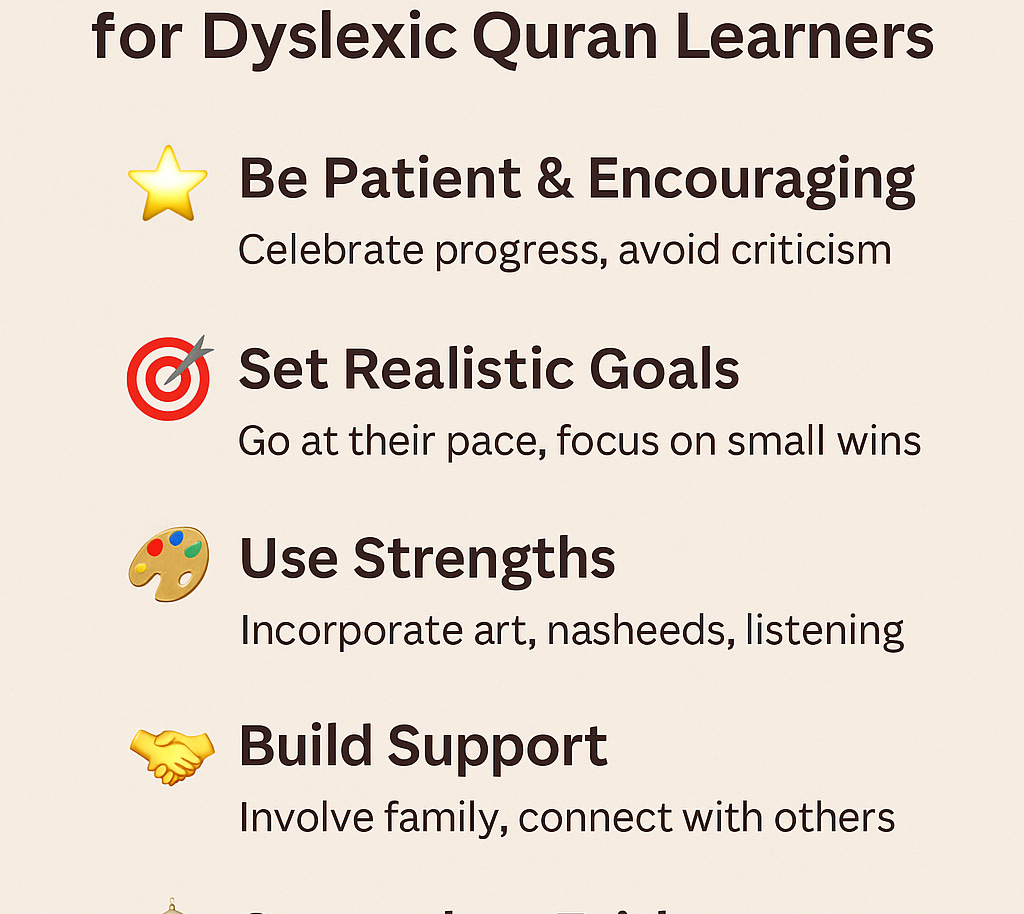
Patience and Positive Reinforcement: Dyslexic kids may take longer to reach milestones, but with patience they do reach them. Avoid showing disappointment or frustration when a child struggles with a word – instead, celebrate small victories. For instance, if a student previously could not recognize the letter ع at all, and now after practice they can recognize it (even if slowly), acknowledge that progress: “Mashallah, last month you hadn’t learned ‘ayn, and now you have – see how your effort is paying off!” Consistent encouragement boosts their confidence, which is half the battle. An Islamic parenting counselor advises: praise him every time he tries, even if the attempt isn’t fully successful [11]. This builds motivation. Conversely, never scold or shame a dyslexic child for Quran mistakes. Negative comments like “Why can’t you remember this, your brother learned it faster” are very harmful. It’s important that the child associates Quran learning with love and patience, not stress. Remember, the Prophet (pbuh) said, “Whoever does not show mercy will not be shown mercy” – so approach the lessons with a merciful heart.
Set Realistic Goals and Accommodations: Every child’s journey will look different. For a dyslexic learner, it might mean accepting that progress will be at their pace, not what a curriculum chart dictates. If typically a student finishes Qaida in 6 months, your child might need 12 or 18 months – and that’s okay. Set achievable short-term goals: e.g., this week, recognize all letters up to kaaf. When that is achieved, it’s a win that can be built on. Actionable recommendation: consider focusing on quality over quantity. It might be better that a child reads and understands one short surah really well, rather than rushing through memorizing 10 surahs with poor accuracy. Also, adapt expectations during class or exams. In a group Quran class, perhaps allow the dyslexic student a bit more time, or let them recite second or third instead of first (so they have time to prepare and are less anxious). If the class is reading round-robin style, the teacher could discreetly skip a particularly long ayah for that student or briefly prep them before their turn. These small adjustments can spare the student embarrassment and set them up for success.
Leverage Strengths and Interests: Dyslexic individuals often have stronger auditory, creative, or spatial skills. Maybe your child has a beautiful voice or loves nasheeds – encourage them by pointing out that their recitation (when they know it) is very heartfelt. Maybe they are artistic – let them draw scenes from the Quran or decorate the Arabic letters they are learning. This makes Quran learning less of a dry exercise and more of a holistic experience. For a child who excels at memorization through listening, you might allow them to memorize a surah by repeatedly hearing it, even if their reading of it isn’t perfect yet. This way they still feel a sense of achievement (“I memorized Surah Al-Fatihah!”) which motivates them to keep working on the reading aspect.
Community and Peer Support: It can be useful for the child to know they are not alone. If possible, connect with other Muslim parents who have children with dyslexia. Some communities have started support groups or at least WhatsApp groups to share tips on Islamic education for special needs. Hearing success stories of other dyslexic learners mastering the Quran can inspire your child (and you). Perhaps invite an older dyslexic student who now reads well to meet your child and share how they overcame the difficulties, providing a role model. Within the family, educate siblings and relatives to be supportive – for example, an older sibling can practice Quran with the dyslexic child in a kind way (not teasing them for mistakes but helping them gently). This creates a network of encouragement around the learner.
Faith and Dua: As Muslims, we believe in the power of dua (supplication) and barakah in learning. Encourage the child to make dua asking Allah for ease in reading His Book – this instills a direct personal connection and hope. Begin each study session with a brief prayer like “Rabbi zidni ilma” (“My Lord, increase me in knowledge”). Remind the child (and yourself) that their effort is noticed by Allah, and that every letter they struggle through carries reward. There are hadiths where the Prophet (pbuh) specifically mentioned that the person who reads the Quran with difficulty gets double the reward – one for reading and one for the struggle endured. Share this glad tiding with your dyslexic student: they are getting extra credit in Allah’s sight for every bit of effort! This can reframe their mindset from “I’m bad at this” to “My effort is valuable and rewardable.” It also emphasizes that learning Quran is not a race; it’s an act of worship and personal growth.
By combining these supportive strategies with the technical ones, we address the whole child: their mind and their heart. A teacher in Karachi recounted an example of one of her students who had severe dyslexia. Initially, the girl would cry out of frustration when asked to read even 2-3 words. The teacher shifted to a slower pace, used a large-print Quran, and spent a lot of class time just talking encouragingly about the verses’ meanings and doing listening exercises. The student’s mother likewise reports focusing on making Quran time calm and loving at home. Over a year, the girl’s reading improved dramatically – but just as importantly, she began to look forward to Quran class. This attitude change was pivotal. It shows that when a dyslexic learner is supported emotionally and taught with tailored methods, the barrier begins to break down. They realize, “Yes, I can do this—on my own timeline, in my own way.”
Real-Life Snapshots: Triumphs in Teaching Dyslexic Learners
To illustrate these strategies in action, let’s look at a couple of real-life inspired case scenarios (names have been changed) that show how, with creativity and determination, dyslexic learners can thrive in Quranic education.
Case Study 1: “Ahmad’s Journey with Ustadh Bilal”
Ahmad is a 10-year-old in London who was struggling tremendously in his evening madrasa class. While other children his age progressed from the Qaida to reading Juz’ Amma, Ahmad was still stuck recognizing basic letters and would often pretend to be sick to avoid class. His teacher, Ustadh Bilal, noticed that Ahmad was bright and eager to please but would freeze when asked to read – often saying letters that weren’t there, or skipping lines. Suspecting a learning difficulty, Ustadh Bilal spoke with Ahmad’s parents and learned that he had just been diagnosed with dyslexia by an educational psychologist at school. Armed with this knowledge, the teacher decided to try a different approach with Ahmad.
First, he removed any time pressure. He set aside 10 minutes of one-on-one time with Ahmad before the group class each day. In those 10 minutes, they went back to basics using a Noorani Qaida booklet. Ustadh Bilal used multisensory techniques: he had a small tray of sand, and Ahmad would “write” the Arabic letters in the sand with his finger while saying the sound. When learning the vowel marks, they used different colored sand for each vowel (red sand for fatha, blue for damma, etc.) to create a visual association. Ahmad absolutely loved this tactile approach – it felt like play rather than remedial work. Over a few weeks, his letter recognition solidified for the first time.
During the main class, instead of asking Ahmad to read long lines from the Quran in front of peers, the teacher adapted the routine. For example, if the class was reading a verse, Ustadh Bilal would perhaps have Ahmad read a shorter phrase from that verse, or echo-read (the teacher reads a part, then Ahmad repeats). If Ahmad made a mistake, instead of immediately correcting in the traditional way, the teacher would gently ask the class, “Let’s all try that word together,” so it didn’t single out Ahmad’s error but still provided correction. This supportive atmosphere meant Ahmad no longer dreaded being called on; he knew he wouldn’t be mocked or embarrassed.
The teacher also enlisted technology: he encouraged Ahmad’s parents to use a Quran app at home where Ahmad could listen to the day’s lesson verse on repeat. They found an app (Quran Companion) that highlighted words as it played recitation. Ahmad would use it at home to practice, almost like karaoke for Quran. Bit by bit, his confidence grew. After 6 months, Ahmad progressed to reading full ayat from the Quran aloud. It was still slow and deliberate, but accurate. His classmates noticed his improvement and cheered him on (thanks to the positive tone set by Ustadh Bilal). By the end of the year, Ahmad proudly participated in the class’s end-of-year presentation, reciting Surah Al-Fatihah from memory and from the Mushaf. His parents were in tears at how far he had come. “The key,” said Ustadh Bilal in an interview, “was to recognize that Ahmad just learns differently. Once we tapped into that – using touch, color, sound – he blossomed. He told me now he wants to become a Hafiz one day. I believe he can, insha’Allah, with this continued support.”
Case Study 2: “Sara and the Quran at Home”
Sara is a 13-year-old girl in Canada who has dyslexia and ADHD. Traditional Quran classes didn’t work well for her; she often felt lost, and the teacher’s scolding when she forgot a tajweed rule only made her more anxious. Her mother decided to take a more personalized approach at home. They set up a special “Quran corner” in the house – a comfy spot with a whiteboard, a set of magnetic Arabic letters, and various Islamic storybooks and audio CDs. The idea was to make Quran learning a multi-faceted experience, not just sitting with a book.
Each day, mother and daughter would spend 20-30 minutes in the Quran corner. One day they might focus on reading a new short surah; another day might be just listening to Quran recitation and humming along. Sara’s mom incorporated a lot of games: for instance, she’d scatter the magnetic Arabic letters and ask Sara to find all the forms of a particular letter (game of letter hide-and-seek), or she’d play “swap the letters” by making a simple three-letter word on the whiteboard (like din) and swapping one letter (bin, din, sin) to show how letters change words. They also used storybooks about prophets that had some Quranic verses in them, reading them together to tie meaning with recitation.
A breakthrough came when Sara’s mom learned about the dyslexia-friendly font “Maqroo” being available as a web plugin. She started printing Sara’s Quran verses in this clearer font with plenty of spacing. Sara exclaimed that it “hurt less to read” when the text was in that format – a revealing comment that reading had been almost physically straining for her before. With larger, cleaner text, Sara’s accuracy improved and she was able to focus on tajweed. They made flashcards together for tricky rules, like a card that said “If you see a small ⃝ (sukoon) on Noon, do ghunna (nasal sound)~” with colors and drawings. Sara would decorate these flashcards herself, which helped her remember the rule.
Motivation was another issue – as a teen, Sara sometimes felt demoralized that younger kids could read fluently while she struggled. To keep her spirits up, her mother showed her videos of famous dyslexic people who achieved great things, and Islamic reminders that Allah rewards effort. They kept a log of her achievements: the day she finished her first full page of Quran, the day she mastered all rules of noon saakin, etc., and would occasionally reward her with something she liked (like a new scarf or a favorite treat) to mark milestones.
Now at 13, Sara has completed reading 3 Juz’ of the Quran with her mother – something they once thought might never happen. It’s still an ongoing journey (they plan to continue slowly until completion), but Sara’s attitude has transformed. “I know I read slow,” she says, “but I love the feeling when I recognize a word from Quran that I learned. It’s like the Quran is becoming my friend.” Her mother’s individualized, patient approach — using everything from magnets to special fonts — exemplifies how understanding the learner is the key. As her mother advises other parents: “Don’t be afraid to teach differently. The Quran’s message is the same, whether you learn it from an app or a teacher or by tracing letters in sand. What matters is reaching your child’s heart.”
These case studies echo a common theme: with the right methods, dyslexic learners can and do make significant progress. The journey may be slower, but it is deeply rewarding. In many instances, these students develop not only reading skills but also an even greater love for the Quran because they’ve engaged with it so interactively. Every obstacle overcome builds their connection and confidence. Their teachers and parents also describe feeling a special joy in witnessing the “lightbulb moments” when a child reads a word independently or finishes a surah. It’s truly a team effort and a spiritual journey for everyone involved.
Conclusion: Embracing the Challenge – Key Takeaways and Recommendations
Teaching a dyslexic learner to read the Quran is not only possible, but it can be a remarkably enriching experience for both the student and the teacher. It requires understanding, innovative methods, and above all, patience and empathy. Let’s summarize the essential points and actionable recommendations for parents and educators:
Understand Dyslexia – A dyslexic student isn’t “lazy” or “unmotivated.” Dyslexia is a real neurodevelopmental difference that affects how they process written language[1]. Recognize the signs early (e.g. persistent letter confusions, extremely slow reading, avoiding reading aloud) and seek an evaluation if needed. Early identification can relieve a lot of anxiety; it shifts the mindset from “What’s wrong with me?” to “Okay, I learn differently and that’s fine.”
Oral and Visual Soaking in the Quran – Remember that Islam has a rich oral tradition. Encourage dyslexic learners to listen to Quran recitation often, even beyond formal study time. This helps them absorb the rhythms and sounds of the Quran naturally. Coupled with that, provide visual exposure to Quranic text in dyslexia-friendly ways (large print, proper spacing, maybe color-coded). Over time, this dual exposure bridges the gap between hearing and reading.
Use Structured, Phonics-based Lessons – Instead of jumping straight into a regular Quran (Mushaf) and expecting the child to decode, use primers like Noorani Qaida which break the learning into small chunks[5]. Go step by step: letters -> syllables -> words -> sentences. Make sure the learner masters each step before moving on. This structured approach builds a rock-solid foundation.
Multisensory, Multi-modal Teaching – Don’t rely on rote visual reading alone. Involve touch (tracing letters, forming clay letters), sound (repeating after audio, verbalizing rules in their own words), sight (colored highlights, pictures), and even movement (hand signals for tajweed). The more senses involved, the better the retention and understanding [5].
Customize the Environment – Create a low-stress, supportive learning environment. This might mean one-on-one sessions rather than group, or a quiet corner at home free from distractions (especially if ADHD co-exists). Minimize anything that might trigger anxiety – e.g., allow the child to use a cover card or ruler to track one line at a time so the page isn’t overwhelming. If writing Arabic by hand is extremely difficult, let them focus on reading and use other means to practice writing (like typing in an Arabic learning game).
Integrate Technology Wisely – Take advantage of modern aids. Use Quran apps with audio highlighting, digital pens, or dyslexic-friendly fonts [9] [10]. These are not “cheating”; they are accelerators of learning. Also consider online tutors or courses if you don’t have local expertise – sometimes a trained specialist can accomplish in 3 months what a well-meaning but inexperienced teacher couldn’t in a year, simply because they know the right methods.
Be Patient and Positive – Perhaps the most important recommendation: exercise a lot of patience, and celebrate every small achievement. Dyslexic kids might make a leap one day and then seem to regress the next – that’s normal. Don’t give up. Consistency over time yields results. Keep the atmosphere positive: use rewards, encouragement, and frame mistakes as “steps to learn.” Avoid comparisons with other students or siblings; instead, compare progress with the child’s own past performance (“See, you know 5 more letters than you did last month, alhamdulillah!”).
Connect with Meaning – Alongside technical reading, ensure the learner knows the meaning of what they are reading in the Quran. Dyslexic learners often have strong comprehension when information is oral or visual. So discuss the verses, watch a short tafsir video or children’s explanation, and allow the child to form a personal connection with the Quran’s messages. This gives them motivation beyond “I have to read correctly” – they start to want to read because they love the stories and wisdom it contains.
Seek Support and Dua – Don’t do it alone if you don’t have to. Reach out to local communities or online forums for Muslim parents of dyslexic kids. Share tips and even swap materials. Sometimes just knowing others are on the same journey helps immensely. And make dua regularly for ease and success – for the child and for yourself as a guide. Our efforts are important, but we ultimately rely on Allah’s help. Many parents recount how after sincere duas, they found “just the right resource” or their child made a sudden breakthrough. As always, tie the camel (use all practical means) and trust in Allah.
Conclusion and Key Takeaways
Remember, the journey with a dyslexic learner is a marathon, not a sprint. In conclusion, dyslexia might make Quran reading a challenging quest, but it is a quest that comes with great rewards and is entirely achievable. By breaking the traditional mold and teaching in a way that dyslexic brains learn best, we truly make the Quran a book for everyone, fulfilling the inclusive vision of Islam. The process may require extra creativity, flexibility, and compassion, but it also brings out the best in educators – forcing us to improve our pedagogy and embody the patience taught by our Prophet (pbuh). And for the learner, overcoming this obstacle can be a source of immense empowerment and faith-building. As we’ve seen, a dyslexic child who initially said “I can’t do this” can transform into one who says “I love reading Quran” when given the right support. That transformation is worth every ounce of effort.
Ultimately, when these learners succeed, they not only break their own reading barrier, but they also inspire others with the Quranic lesson that with hardship comes ease, and that Allah’s words truly are accessible to all who earnestly seek them. Let’s continue to innovate and advocate so that every Muslim, regardless of reading ability, can experience the light of the Quran.
References:
Shaywitz, S. E., & Shaywitz, B. A. (2003). The prevalence of reading disability (dyslexia) – Estimates range from 5% to 17% of the population. Scrip.org.
Lyon, G. R., Shaywitz, S. E., & Shaywitz, B. A. (2003). Definition of Dyslexia. Annals of Dyslexia, 53(1). International Dyslexia Association.
Carroll, J. et al. (2024). Toward a consensus on dyslexia. Journal of Child Psychology & Psychiatry.
NeuroHealth Clinic. (2021). What Are the Different Types of Dyslexia? Neurohealthah.com.
Resala Academy. (2023). How Noorani Qaida Simplifies Quranic Learning for Dyslexic Learners. Resala-academy.com.
Ramli, S., et al. (2016). Do Children with Dyslexia Have Difficulty in Reading the Quranic Verses Too? Creative Education, 7(7), 1018-1023. Scirp.org.
Hiba Magazine. (2009). Dyslexia: The Reading and Learning Disability by Sadaf Farooqi. Hibamagazine.com.
Islamiqate. (2019). Does Islam recognize dyslexia as a real illness? Islamiqate.com.
Schwarz, H. (2024). Can this Arabic font help readers with dyslexia? Fast Company. Fastcompany.com.
Ragab, T. (2023). A Dyslexic’s Guide to Reading Quranic Arabic. IJAAZAH Academy Blog. Ijaazah.com.
AboutIslam.net. (n.d.). How to Help My Child With Dyslexia? Q&A. Aboutislam.net.
Elbeheri, G., Everatt, J., Reid, G., & Al-Mannai, H. (2006). Dyslexia Assessment in Arabic. Journal of Research in Special Educational Needs, 6(3), 143–152.
British Dyslexia Association. (2020). Dyslexia Style Guide.
Learning Roots. (2020). Kiitab Interactive Quran Base.
U.S. Department of Education. (2017). Multisensory Instruction for Dyslexic Students (Workshop brief).