

Understanding the Problem
Auditory Processing Disorder (APD) is a neurological condition where the ears hear sounds perfectly well, but the brain struggles to interpret and make sense of those sounds. In practical terms, a child with APD might hear someone speaking but have trouble understanding the words – especially in less-than-ideal listening conditions. Clinically, APD is defined by deficits in how the central auditory nervous system processes information: children with APD may have trouble localizing where a sound came from, distinguishing similar speech sounds, recognizing sound patterns, or understanding speech in noisy environments. Importantly, APD is not due to any peripheral hearing loss – the child’s ears are healthy – and it’s not due to intellectual or language deficits [1].
The issue lies in the brain’s processing of auditory signals. Current research estimates that APD affects a significant minority of children. Various studies report prevalence rates ranging roughly from 2–7% of school-aged children, though some estimates go even higher [2]. This variability exists because there is no single agreed-upon diagnostic test or criteria for APD, so different studies measure it differently [3]. In one striking example, a 2013 study found anywhere from 7% to 96% of referred children met criteria for APD depending on which tests were used – highlighting the ongoing debate in the field. Nonetheless, a reasonable estimate is that roughly one in twenty children may be affected, which means in a typical classroom or weekend Quran class, it’s quite possible at least one student has APD.
Reported prevalence of APD in school-age children varies across studies. Some large-scale screenings have found rates as low as 0.2%, while other research and expert estimates suggest 3–7% or more of children may have some form of APD. Differences in diagnostic criteria account for the wide range [3].

For parents and teachers, it’s important to recognize the signs and symptoms of APD. Often, these children will act as if they have a hearing loss – saying “What?” frequently or needing information repeated, even though their actual hearing test is normal. They might have difficulty understanding speech in a noisy room or when more than one person is talking [1]. In a quiet one-on-one setting they may cope fine, but add a bit of background chatter or an echoey room, and the child may shut down or respond inappropriately because they couldn’t decipher the words. Children with APD typically take longer to respond to oral communication because their brains need extra time to process what was said [3]. Following multi-step verbal instructions can be very challenging – if you rapid-fire a sequence like “go to your room, bring your notebook, then put on your shoes,” a child with APD might only catch one or two of those steps [12]. They can also be easily distracted by background sounds that others ignore [3]. Some APD signs are surprisingly specific: for example, many of these kids struggle to learn songs or nursery rhymes [3]. That’s because recognizing the lyrics and the rhythm relies on accurate auditory pattern processing – something their brains have trouble with. Similarly, they might have weak phonemic awareness (recognizing and manipulating the sounds in words) which can impact reading and spelling as well. It’s not uncommon for APD to co-occur with other learning or developmental differences; studies show higher rates of APD in children with ADHD or language disorders, for instance [3]. All of this can make the school (and Quran class) experience frustrating for the child. They’re putting in a lot of effort to listen, but what they hear is often incomplete or jumbled by the time their brain processes it.
To illustrate, imagine you’re a child with APD sitting in a bustling classroom or a busy mosque hall. The teacher says a simple sentence like “Please recite the next verse.” But with APD, your brain might not cleanly separate the teacher’s words from the scraping of chairs or the fan whirring overhead. You catch only “…recite…next…,” unsure what to recite next. Or perhaps the instruction “start at Chapter 2, Verse 5” reaches your ears as a garbled string of sounds. This is the everyday reality for children with APD – it’s as if their ears “don’t cooperate” with their brain. Over time, these kids can become anxious about auditory situations or even tune out as a coping mechanism. Notably, APD is often an “invisible” disorder; the child looks and acts completely typical, and can listen normally in ideal settings, so adults might mistakenly label them as lazy, inattentive, or disobedient. In truth, the child is often trying very hard to listen. Their brain is working overtime to decode sounds, which can be exhausting – a phenomenon known as auditory fatigue [13]. By understanding that APD is a real, research-backed diagnosis – with defined diagnostic criteria and even measurable differences in how the brain responds to sound – parents and teachers can replace frustration with compassion. They can move from “why aren’t you listening?” to “how can we help you understand better?”

From a clinical standpoint, diagnosing APD involves specialized auditory tests usually conducted by an audiologist. These tests go beyond the standard “beep” hearing test. They might include, for example, listening to words with background noise, identifying differences between similar-sounding syllables, or remembering spoken numbers in sequence. Children are often not formally tested for APD until around age 7 or 8, since younger kids’ auditory systems are still developing. There is no single universally agreed test battery, which as mentioned contributes to varied prevalence rates. However, professionals like audiologists and speech-language pathologists follow guidelines (such as those from ASHA and the American Academy of Audiology) to assess a range of auditory processing skills. Generally, if a child performs poorly (below a certain cutoff) on two or more of these specialized tests and other issues have been ruled out, an APD diagnosis may be given [3]. An important part of the evaluation is also to ensure that any apparent auditory processing difficulty isn’t actually due to something else – for instance, an attention problem or the child not understanding the language. True APD is diagnosed only when the issue is in processing sounds, not a broader cognitive or language impairment (though, as noted, APD can coexist with those). Sometimes a history of frequent ear infections in early childhood is reported in kids who are later diagnosed with APD. Research has linked chronic otitis media (middle ear fluid/infections) to auditory processing deficits – possibly because those early bouts of muffled hearing during critical language periods slightly altered how the brain’s auditory pathways developed. Other proposed causes or contributors include premature birth, head injuries, or genetic predisposition. In many cases, the exact cause is unknown – the APD just is. There’s no “quick cure” or medication for APD [5], but the good news is that with the right strategies and support (as we’ll explore), children with APD can successfully learn and thrive.

Challenges in Quran Learning
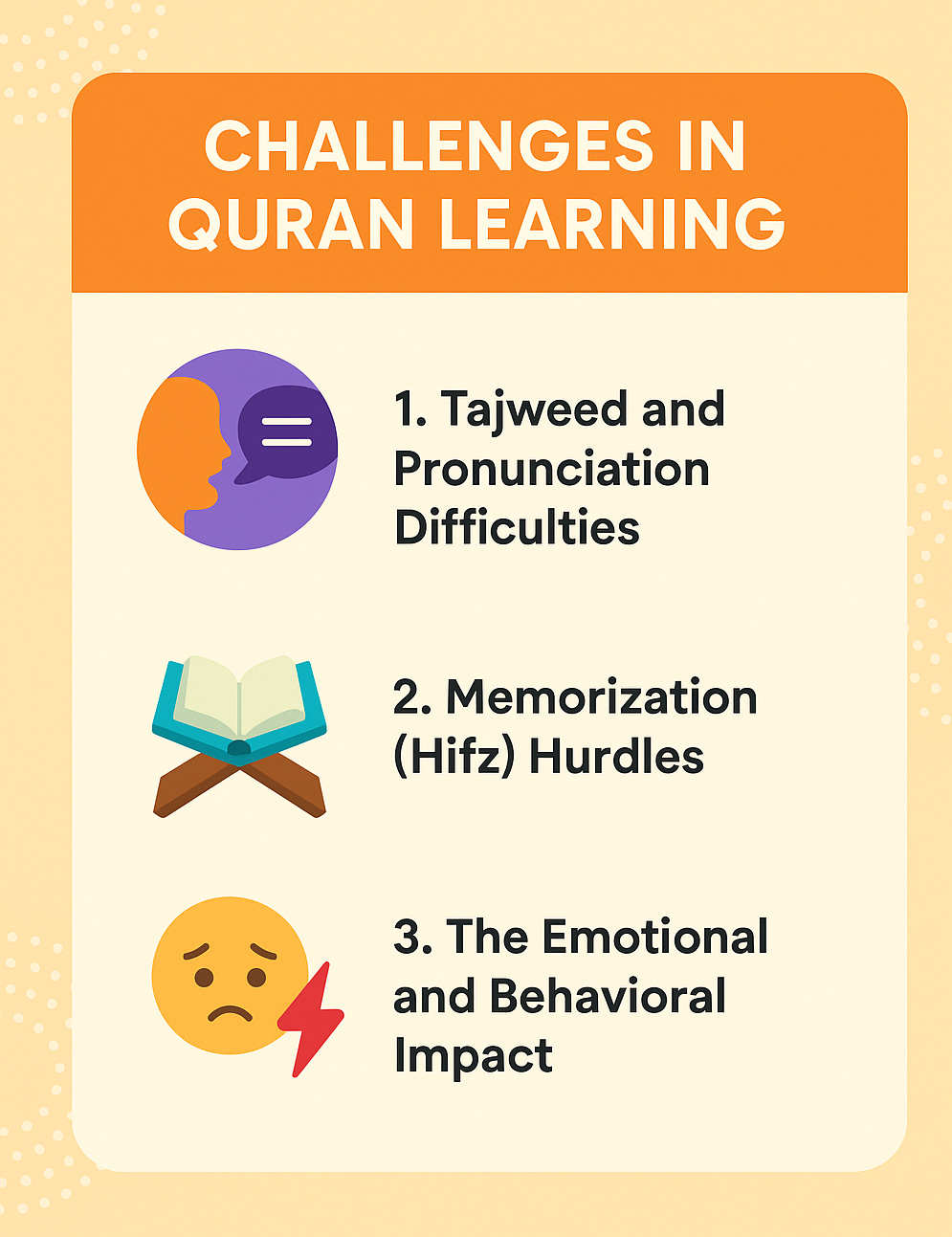
Learning to read and recite the Quran is a highly auditory experience, especially in the traditional teaching methods used in many communities. For a child with APD, this can present a unique set of challenges. An alternate title for APD could well be “When the ears don’t cooperate,” because these children’s ears seem to play tricks on them – and that becomes especially apparent during Quran lessons that rely on listening and repeating. Let’s break down some of the specific hurdles such children might face:
1. Tajweed and Pronunciation Difficulties:
Tajweed – the rules governing correct pronunciation and recitation of the Quran – requires the ability to hear and reproduce very subtle differences in sounds. Arabic is rich in similar-sounding letters that have distinct pronunciations (for example, س seen vs ص sād, or ذ dhal vs ز zāy). Mastering these distinctions is challenging for any non-native learner, but for a child with APD it can be truly daunting. Auditory Processing Disorder, by its nature, means having “difficulty hearing differences between sounds” [6]. So an APD child might genuinely not hear the difference between, say, ع (ayn, a deep throaty sound) and أ (alif, a glottal stop), even if their teacher repeats it over and over. The result is that the child may pronounce the letters or words incorrectly without realizing it. For instance, the child might recite “Qul huwallahu ahad” but due to mishearing, it comes out sounding a bit off – perhaps mixing up a letter in “ahad”. A teacher who is unaware of the APD might think the child is being careless or needs to try harder, when in fact the child is trying very hard but perceiving the sounds fuzzily. Tajweed also involves rules of elongation (stretching a vowel for two counts versus four counts, etc.) and nasalization (the ghunnah sounds). These are subtle auditory cues – a child must hear how long a sound is held, or detect a nasal quality. APD often includes deficits in processing temporal aspects of sound (timing) and auditory pattern recognition [3], which translates to difficulty noticing things like the difference between a short vowel and a long vowel. The child might not catch that a madd (elongation) was supposed to be 4 beats long, or that a certain nun sound was nasalized, because to their brain those details get lost. All this can make proper Quran recitation a steep hill to climb. It can be disheartening for a child when they constantly hear “No, listen closely, that was wrong” for sounds that they thought they said correctly – simply because their auditory perception led them astray.
2. Memorization (Hifz) Hurdles:
Memorizing Quranic verses (doing hifz) traditionally relies heavily on auditory learning – the teacher recites or the child listens to an audio, and the child repeats it again and again until it’s committed to memory. But consider what memorization entails for a child with APD. First, they need to accurately hear each word or verse. As we discussed, that’s a challenge in itself. If the input is a little distorted in their mind, what they attempt to memorize might be a distorted version. Many APD students have trouble with auditory memory – holding onto sequences of heard information [2]. So even if they hear the first part of a verse, by the time the teacher reaches the end, the beginning might have gotten fuzzy in their memory. For example, a boy with APD trying to memorize Ayat al-Kursi might hear “Allahu la ilaha illa huwal hayyul qayyum” and start repeating in his head “Allahu la ilaha…” but as he focuses on the next part, he’s already lost track of the exact wording of the first part. These children often need many more repetitions to learn the same material. They may also memorize incorrectly because of misheard sounds and then have a hard time re-learning it the correct way later. Another hurdle is that Quran memorization often happens in environments with other kids around – in group classes, multiple children might be reciting out loud at the same time (common in madrasa or Sunday school settings). This creates a wall of sound that can be extremely difficult for an APD brain to parse. One mother described her son with APD trying to learn in a group of enthusiastic young boys as “trying to catch a single soft voice on a busy street corner” – his brain simply could not pick out the teacher’s voice from the chorus of others. The result: he fell behind and often recited the wrong line because he was effectively guessing what part they were on. Listening comprehension of Quranic lessons can suffer too. If the class involves not just rote recitation but also listening to the teacher explain the tafseer (meaning) or tell stories of the Prophets, an APD child might catch only bits and pieces. For instance, during Ramadan a teacher might narrate the story of a Quranic verse’s revelation. An APD child, sitting toward the back, hears a few words like “...Prophet… cave… hear voice…” and by the end of the story, they haven’t truly followed the narrative. They might then disengage or look bored, when in reality they wanted to listen but just couldn’t process the flowing speech fast enough. This can be discouraging because the child doesn’t get the enriching parts – the morals, the context – that make Quran learning meaningful, potentially leaving them less motivated.
3. The Emotional and Behavioral Impact:
Beyond the direct academic difficulties, APD can also create emotional challenges that indirectly hinder Quran learning. A child who is constantly corrected or who frequently experiences the confusion of mishearing may start to dread Quran class. They might act out or become disruptive as a cover for not understanding – for example, a child might make a joke or distract classmates whenever it’s time to listen to a new lesson, as a way to deflect from the fact that they didn’t catch what was said. Some kids become withdrawn and quiet in class, not volunteering to recite or answer questions, because they fear they’ll get it wrong. Teachers might misinterpret this as lack of interest. In religious learning environments, there’s sometimes an added layer of pressure: children are told that learning the Quran is very important, something to do with one’s heart and soul. An APD child who struggles might internalize a painful thought: “Maybe I’m not a good Muslim because I can’t do this.” It’s crucial to recognize this as a false thought – the child’s difficulties have nothing to do with will or faith, only with a neurological processing issue. But without awareness, that guilt or lowered self-esteem can creep in. Parents too may unintentionally put extra pressure (“Why can’t you recite like your sister did at your age?”), not realizing the child is genuinely trying. All of these factors – frustration, anxiety, feeling “dumb” or “naughty” when they’re not – create a negative feedback loop. The more stressed and demoralized the child becomes, the harder it is for them to focus and make progress in learning the Quran. In summary, APD introduces barriers at every stage of the Quran learning process: hearing the teacher correctly, processing the rules of tajweed, retaining verses in memory, and staying confident and engaged. Recognizing these hurdles is the first step toward addressing them. The good news is, as we’ll see next, there are evidence-based strategies and tools to help overcome each of these challenges.
Evidence-Based Solutions
Learning the Quran might be an auditory-intensive task, but that doesn’t mean children with APD cannot succeed at it. On the contrary, with the right evidence-based interventions and supports, these kids can flourish. Modern research in audiology and education has identified a number of strategies to help children with APD improve their auditory skills or work around their weaknesses. Let’s explore some solutions and how they can be applied to Quran learning. (We’ll follow the science, but explain it in a parent-and-teacher-friendly way.)
1. Improving the Signal: Technology to the Rescue
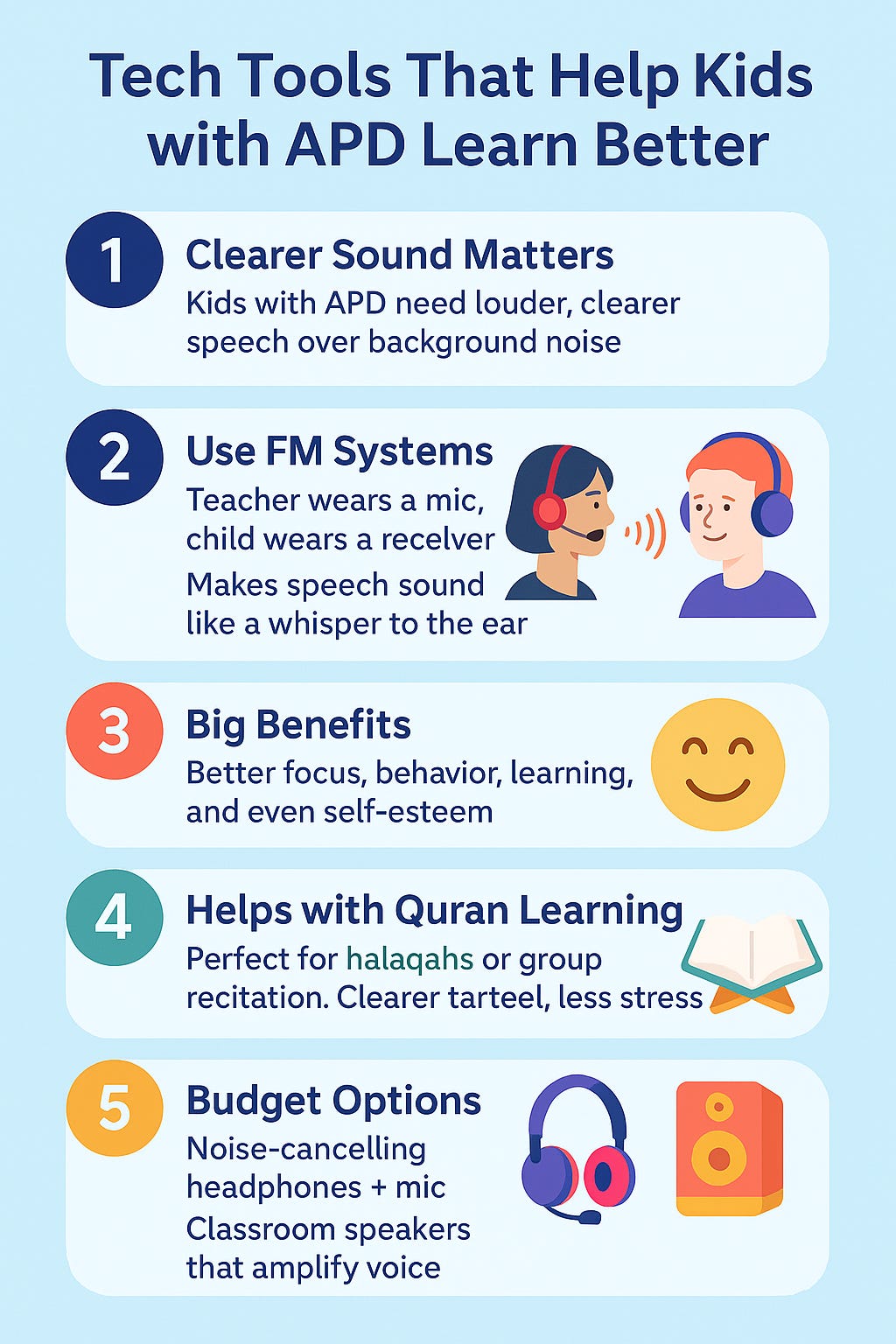
One of the simplest and most effective interventions for APD is to improve the quality of sound that the child’s brain receives. In technical terms, this means enhancing the signal-to-noise ratio – making the important sound (e.g. the teacher’s voice or Quran recitation) louder and clearer relative to any background noise. A well-proven tool for this is the personal FM system. An FM system is an assistive listening device where the teacher wears a small microphone transmitter and the child wears a receiver (often like a special hearing aid or headphones). The teacher’s voice is transmitted directly to the child’s ear, as if the teacher were speaking right next to them, crystal clear [13]. This cuts through the room noise, echo, and distance that normally would degrade the sound by the time it reaches the child. Research has shown remarkable benefits of FM systems for kids with APD. In one study, children with APD who used an FM system every day for a school year showed significant improvements in their ability to understand speech in a noisy classroom, better academic performance, and even positive changes in behavior and self-esteem [8]. In fact, their listening scores in noise improved so much that over time they performed closer to typical children. There’s even evidence that prolonged use of such systems may help “train” the brain: after using FM for months, some children’s unaided listening (without the device) also improved – suggesting the auditory system can develop with the consistent clarity provided [8]. For our Quran class context, an FM system could be a game-changer. Imagine the Friday night halaqah where 15 kids are reciting together – normally an APD child might catch only snippets. But if the teacher or Quran tutor uses a lapel microphone and the child has the receiver, suddenly the teacher’s tarteel (recitation) comes through loud and clear, as if whispered directly to the child’s ear. No more struggling to pick out the teacher’s voice from the crowd. This can also be used at home: a parent helping the child practice Quran could wear the mic, ensuring their corrections and cues aren’t missed. If an FM system device is too costly or impractical for some settings, there are simpler tech solutions – for example, a good quality noise-cancelling headphone paired with a microphone system, or even using a sound field speaker in a small classroom (a speaker that amplifies the teacher’s voice to the whole room, which benefits all students somewhat). The key idea is supported by research and recommended by audiologists: reduce background noise and enhance the clarity of the spoken (or recited) word [7]. This is a foundational step for any APD child. It sets the stage so that other learning can actually “get through.” Think of it like giving a nearsighted child a pair of glasses – suddenly, what was blurry (in this case, auditory information) becomes clear enough to work with.
2. Auditory Training and Therapy
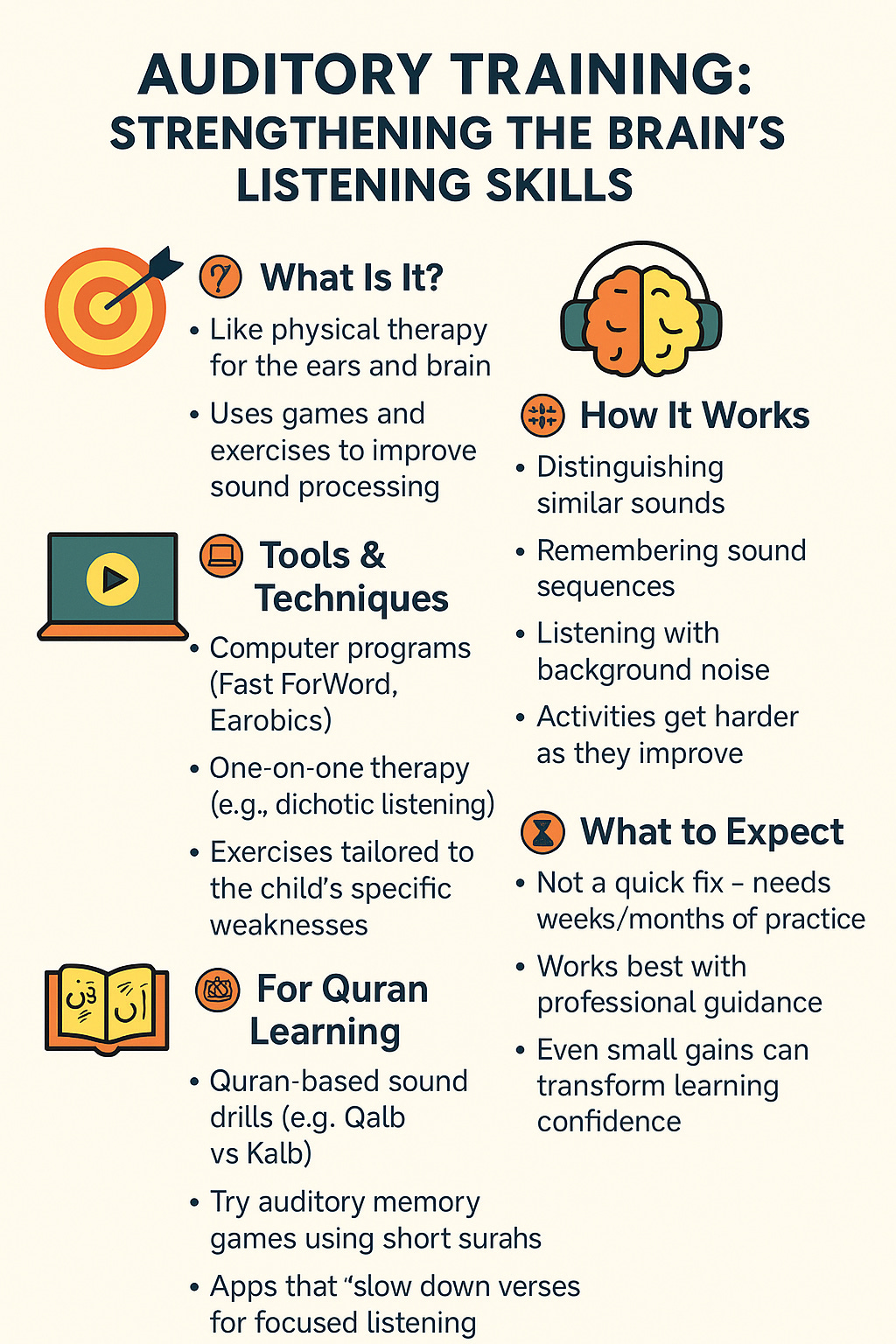
While technology can help manage the listening environment, another approach is to train the brain itself to process sounds better. This is often done through specific therapeutic programs known as auditory training. The concept is akin to physical therapy for your ears and brain: through repeated exercises, we try to improve the brain’s auditory pathways (thanks to neuroplasticity). What does auditory training look like? It can take many forms, but typically it involves games or exercises that require the child to differentiate sounds, remember sequences of sounds, or listen in challenging conditions, gradually increasing difficulty as they improve. Some are computer-based programs that adapt to the child’s performance – for example, the software might stretch out and amplify certain parts of speech and then gradually make them faster as the child’s processing improves [7]. Well-known programs in this realm include Fast ForWord and Earobics, among others. Other training might happen one-on-one with a therapist, practicing specific skills like dichotic listening (where different sounds are played in each ear) to improve the brain’s ability to handle multiple inputs. Does auditory training work? The research is promising, though with some cautionary notes. For instance, a study in Brazil had children with APD undergo an 8-week training program and measured their brain’s electrical responses to sounds before and after. After the training, the children’s auditory brain waves showed significantly stronger and faster responses – essentially their brains were catching sounds more like a typical listener’s would [10]. This kind of objective improvement suggests real changes in auditory processing ability. Other studies have found improvements in skills like phonemic discrimination and listening in noise after targeted training. However, not all studies show general benefits to real-world learning or academics – some improvements might be very specific to the tasks trained. Experts agree that any auditory training should be evidence-based and supervised by professionals, and it should target the particular weaknesses a child has (for example, if tests show a big problem with auditory sequencing, training might focus there). For Quran learning, how might this translate? If a child with APD is struggling with, say, differentiating similar Arabic sounds, a training approach could involve drilling minimal pairs of Quranic words (words that differ by only one sound) – essentially an auditory discrimination exercise using Quran vocabulary. For example, practice hearing the difference between Qalb (heart) and Kalb (dog) – a classic pair that differ only by the subtle Q vs K sounds. Or an auditory memory game using short Quranic phrases: the teacher reads two short phrases and the child points to which one was spoken, gradually increasing length. There are even emerging digital tools: some apps can play Quran verses in a slowed, highlighted manner; these could double as auditory training by encouraging the child to actively listen for specific letters or tajweed rules as they follow along. It’s important to note that auditory training is not a quick fix – it may take weeks or months to see improvement, and it’s often used in combination with other supports. But it addresses the root processing issues and can yield lasting benefits in how the child hears all speech (not just during Quran class). Even modest gains in auditory processing can make a big difference: perhaps now the child can distinguish “tha” and “sa” sounds better, or can pick up spoken instructions with one repetition instead of three. Scientifically, this area is still being studied, but the underlying principle is solid – the brain can change, especially in children, and targeted practice can improve auditory skills [10].
3. Multimodal and “Top-Down” Supports
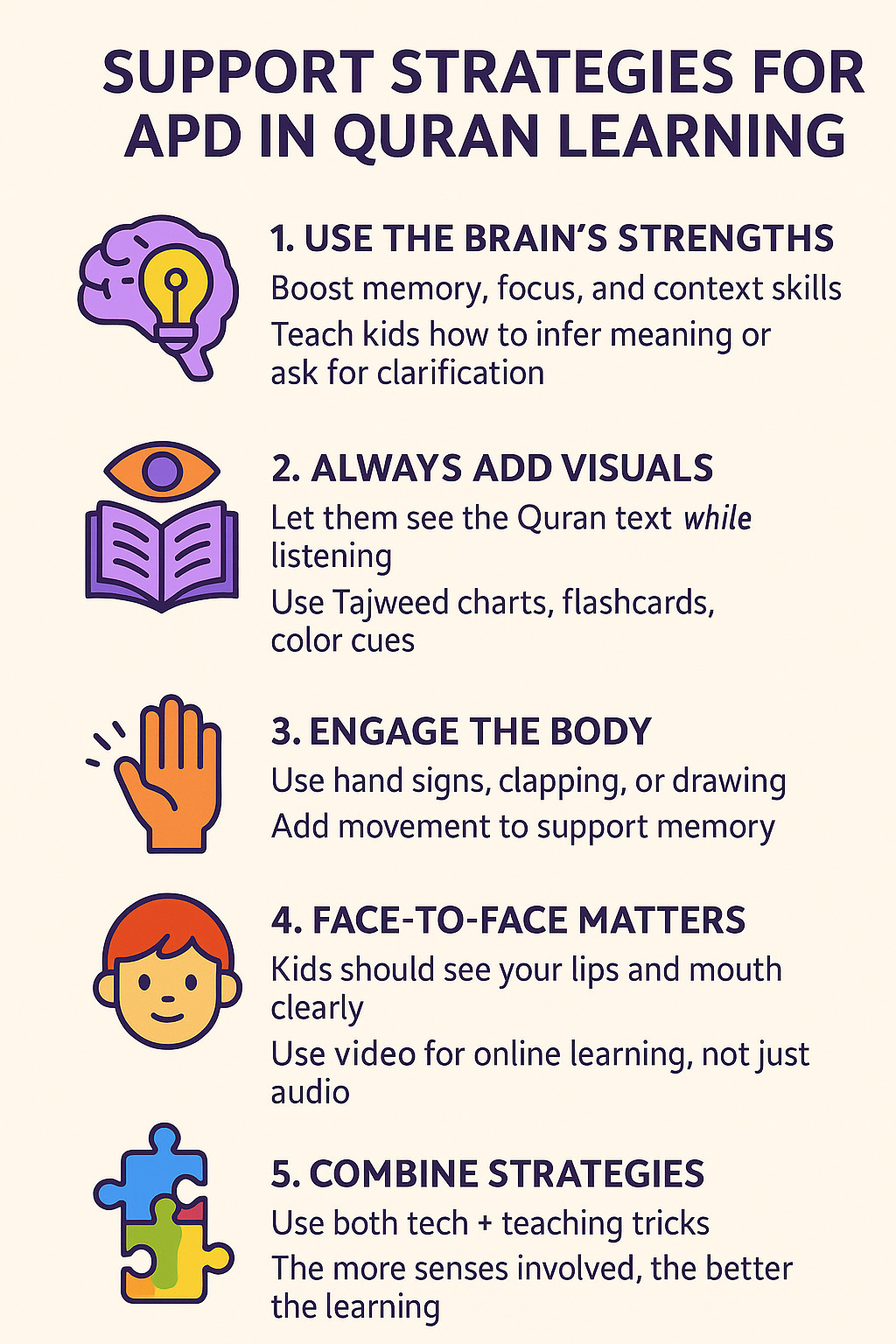
An equally important set of solutions doesn’t focus directly on the ears at all, but rather on leveraging other strengths and strategies to compensate for auditory weaknesses. These can be thought of as top-down interventions or multimodal approaches, and they are well-supported by educational research. Top-down means we try to improve higher-level skills like language, attention, memory, and problem-solving, which in turn help the child deal with imperfect auditory input. Multimodal means using other senses (visual, kinesthetic) alongside hearing to reinforce learning. In practice, what does this look like? For a child with APD learning Quran, a top-down strategy might be explicitly teaching them contextual cues and repair strategies. For example, if they didn’t catch a word, teach them to infer from context (“We’re talking about Prophet Musa, so that word might have been ‘Musa’”) or to ask for clarification (“Did you say verse 15 or 50?”). These children can be taught active listening strategies: like silently rehearsing what they did hear to hold it in memory while asking for repetition of what they missed – a sort of cognitive trick to fill gaps. Building up working memory and attention span through games and exercises can also help them hold on to what they hear longer. [11] In Quran class, a teacher using top-down support might pre-teach key vocabulary or the gist of a passage before having the child listen to recitation, so the child’s brain has a framework to slot the sounds into. This aligns with the idea that APD kids do better when they can use their knowledge and expectations to assist auditory perception (e.g., knowing the topic is a prayer of Prophet Ibrahim may help the child mentally predict some of the Arabic words they will hear).
Multimodal support, on the other hand, means don’t rely on audition alone. See it, hear it, maybe even touch it. For Quran learning, this is crucial. If a child has APD, make sure they have the text in front of them when learning to recite. Hearing and reading simultaneously gives the brain two inputs for the information (visual and auditory), drastically increasing comprehension and retention for APD learners [12]. Many Quran teachers encourage memorizing by listening only (to develop listening skills), but in the case of APD, allowing the child to follow along with a finger on the text or to look at a mushaf (Quran book) while the verse is read can anchor the sounds to written words. Colorful Tajweed rule charts or flashcards can provide visual cues for sounds (for example, showing the mouth/throat position for specific letters). Another multimodal tool: get kinesthetic. Some children benefit from a physical component – for instance, clapping out the rhythm of a verse or using hand signals for certain tajweed rules (some teachers use a system of hand signs to indicate where to elongate or where to make a nasal sound). These tactile or movement-based cues engage the child’s memory in different ways. Even simple things like writing the verse on a whiteboard as they recite, or drawing a quick sketch of a word’s meaning, can reinforce learning through additional pathways.
One particularly powerful multimodal technique is to ensure visual access to speech – basically, let the child see the teacher’s face and mouth clearly. Children with APD often benefit from lip-reading cues unconsciously [12]. The way the lips and tongue move can make sounds look more distinct, helping the brain “hear” them better. In a Quran learning context, this means the teacher or parent should face the child and articulate clearly (which they likely do anyway for tajweed). If the child is learning via an online class, using video (not just audio) can help, so they can see the teacher’s mouth. Some families even explore using basic sign language or visual symbol systems for key instructions. For example, a teacher might establish a hand signal for “listen” versus “repeat,” so the APD child isn’t relying purely on hearing those words amidst others. Interestingly, some people with APD report that learning sign language (like ASL) gave them a useful alternative channel for communication [5]. While a full sign language might not be necessary for Quran learning, this underscores how important visual channels can be.
The scientific basis for multimodal strategies is straightforward: by engaging multiple parts of the brain, you reduce the load on the auditory circuits. Brain imaging studies show that when people listen and look at corresponding visuals, more brain areas light up and comprehension improves. For APD children, this can make the difference between information being lost versus retained. As one review put it, the best practice often is a combination of bottom-up and top-down approaches – improve the auditory signal where you can, train the auditory skills directly, but also teach the child strategies and use other senses to support them [8]. In other words, throw multiple tools at the problem. Fortunately, none of these strategies conflict with religious or linguistic requirements. They are simply supports to help the child learn the Quran’s words correctly and meaningfully.
4. Therapeutic and Collaborative Supports
It’s worth noting that many children with APD benefit from the involvement of speech-language pathologists (SLPs) or other specialists. An SLP, for instance, might work with the child on phonological awareness (the sound structure of language) and language comprehension techniques. If a child with APD also has a language processing issue, therapy can bolster their vocabulary and understanding, which in turn can make learning Quranic Arabic easier (even if they’re just learning rote, understanding general meanings or cognates can help the brain predict and differentiate similar Arabic words). There are also auditory processing specialists and audiologists who might provide one-on-one training or introduce assistive technology. Collaboration is key: parents, secular teachers, Quran teachers, and therapists ideally should communicate about what works for the child. For example, if at school the child has an accommodation (like “give written instructions” or “preferential seating at front”), the weekend Quran teacher can implement the same. If the child uses an FM system in class, see if it can be made available during Quran sessions too. Scientific literature emphasizes environmental modifications as a primary management strategy: things like minimizing echo (maybe holding Quran class in a carpeted room or closing the door to hallway noise) and seating the child away from noise sources [7]. Even simple steps such as using a soft voice instead of a loud echoing voice, or providing a personal copy of written notes for a lesson, have evidence behind them in improving APD kids’ performance [12]. Additionally, if the child has any co-occurring issues (ADHD, for example), addressing those (with medication or behavioral strategies) can indirectly improve auditory attention too. Some APD children, especially if easily fatigued, may benefit from shorter but more frequent practice sessions rather than one long session. Research on learning efficiency suggests distributed practice (short, frequent review) aids memory – tip number 10 from learning experts is to review new material daily in small doses [12]. This is especially relevant for Quran memorization: instead of one long cram session, a child with APD might do better with two 10-minute practice sessions, perhaps once after school and once after dinner, to reinforce the verses.
In summary, there is a robust toolkit of evidence-based solutions for APD: from hi-tech devices that clarify sound, to training programs that build listening skills, to strategic teaching methods that use visuals and context. Scientific studies back the effectiveness of many of these interventions – for instance, personal FM systems have demonstrated clear gains in listening and academic outcomes [8], and controlled trials of auditory training show measurable changes in the brain’s auditory responses [10]. Perhaps most importantly, the research underscores that a multi-pronged approach is best [11]. There’s rarely a one-shot cure, but combining supports offers the child multiple avenues to succeed. For a child learning the Quran, this means we should optimize the environment (quiet, clear sound), boost their skills (through practice and maybe therapy), and adapt our teaching methods (with visuals, patience, and repetition). With these measures, APD can be managed effectively – and what once seemed like an “impossible” learning task can become very achievable.
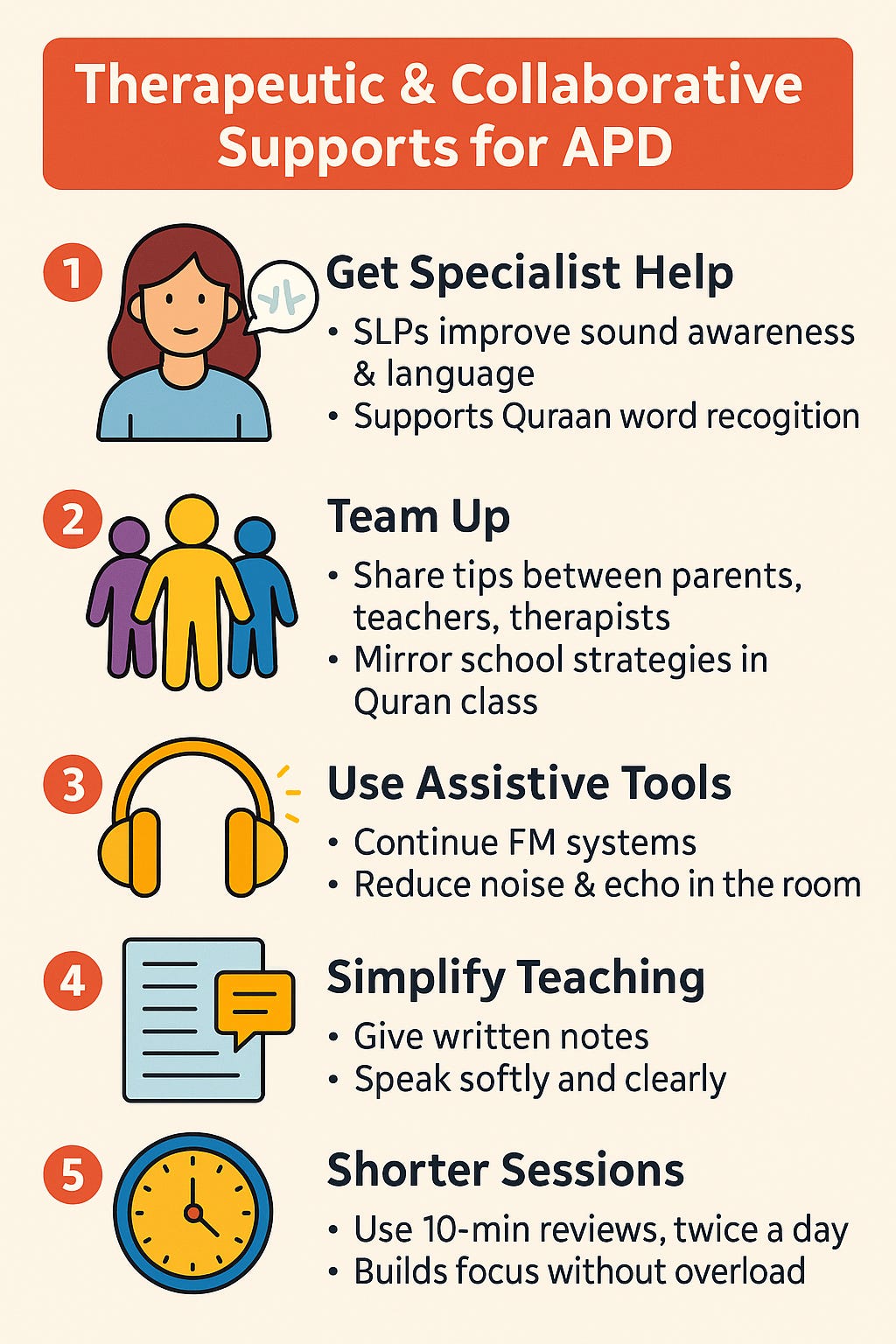
Guidance for Parents and Teachers
Knowing the challenges and solutions in theory is one thing – but how do we implement them on a day-to-day basis? This section provides practical, compassionate guidance for parents and teachers helping a child with APD learn the Quran. The tone here is intentionally encouraging: remember that progress may be slow, but it will come with the right support. The goal is not to “fix” the child’s APD (which isn’t a realistic expectation) but to give the child the tools and environment they need to learn effectively and to feel confident doing so. Here are some key strategies:
Optimize the Learning Environment:
The ideal setting for an APD child to learn is one with minimal background noise and distractions. This might mean choosing a small, quiet room for Quran practice rather than a large echoey hall [12]. If you’re in a mosque or school with noise, consider simple sound fixes: close the door, turn off any unnecessary fans or devices, use carpeting or cushions to dampen echo. If other children are present, establish ground rules that only one person recites at a time while others listen quietly (this helps everyone, not just the APD student!). Preferential seating is a must – have the child sit close to the teacher or reciter, ideally where they can see the teacher’s face clearly. If it’s a group class, seat the APD child away from any noisy doorway or window. Good lighting is also important so that visual cues (like the teacher’s mouth movements or the text) are easily seen. These adjustments are grounded in the principle of improving the signal-to-noise ratio and have been recommended by experts for decades [7]. Think of it as creating a listening-friendly zone. It’s worth explaining to the child’s peers (in an age-appropriate way) why you’re making these changes – fostering a supportive class environment (“We all concentrate better without extra noise, let’s help each other focus”). Often classmates are very understanding when they know a friend needs a bit of quiet to hear well.
Speak Slow, Clear, and Pause Frequently:
As a teacher or parent, you may need to adjust your speaking style. Slow down the pace of instruction and recitation, and enunciate each word distinctly [12]. This doesn’t mean you have to sound unnatural or robotic, just be mindful not to rattle off sentences at high speed. After saying a sentence or an instruction, pause for a couple of seconds to give the child’s brain time to catch up. This little “lag time” can make a world of difference – you might be amazed that simply waiting 3–5 seconds before expecting a response can improve the child’s ability to follow what you said. For example, if you’re teaching a new verse, recite the verse once, then wait and look at the child to see if they are ready to try repeating. If you just plow ahead, the child may still be processing the first few words while you’ve moved on. Also, be concise. Children (and adults!) with APD struggle with lengthy oral explanations or multi-clause sentences [12]. Break instructions into one step at a time. Instead of saying, “Go to the shelf, get the green Quran, then find Surah Maryam and start from the second ayah,” you’d break that into chunks: “Go to the shelf and bring the green Quran.” (Once the child does that or acknowledges), then: “Open to Surah Maryam.” (Wait for it.) “Now find ayah number 2.” This may feel slow at first, but it prevents the overwhelm and confusion that a long string of verbal information can cause. Remember, visual supports can supplement this: in the above scenario, you might also show a flashcard that says “Surah Maryam, Ayah 2” so the child sees the instruction as well as hearing it.
Use Visual Aids Generously:
As emphasized earlier, involving the eyes reduces strain on the ears. Turn key information into visual form wherever possible. For example, if you’re teaching a tajweed rule, have a poster or diagram of how to pronounce the letter from the mouth/throat. If giving a new vocabulary word or explaining a Quranic term, write it on the board or paper. Many Quran teachers already use a whiteboard to write out difficult words – this is extra helpful for APD kids. During lessons, encourage the child to follow along in the Quran text with a finger or bookmark as you recite. You can also color-code or highlight their copy of the Quran: maybe mark certain letters that they often mis-hear in a different color (e.g., highlight all the ق qaf letters so they remember it’s a deep “Q” sound, distinct from ك kaf). Some parents use Quran copies that have Tajweed color codes (popular print editions where each tajweed rule like nasal sounds, elongations, etc., is marked in color). Those visually cue the child when a rule is applied, reinforcing what they might not pick up by ear. Additionally, incorporate pictures or stories: if a child is memorizing a surah about the elephant (Fil), show a quick picture of an elephant or have them draw one – linking a mental image to the words can aid recall and make learning more engaging. Watching the teacher’s mouth is another visual aid: make sure the child is positioned so they can clearly see your face [12]. If you’re doing online classes, ensure the video is on and your lighting is good. Sometimes exaggerating mouth movements (to a point) for tricky pronunciations can help the child see the difference between similar sounds. Lastly, don’t underestimate the value of written agendas or summaries. If a child is going to attend a Quran class, having a written outline like “Today we will: 1) Review Surah Fatiha, 2) Learn verses 1-5 of Surah Nas, 3) Watch a short video about Prophet Yunus” can prepare them mentally and reduce the auditory load of processing each transition during class.
Be Patient and Positive:
Perhaps the most important guidance is to maintain a compassionate attitude. Children with APD will need more repetition. They will have days where they seem to “get it” and days where they don’t. This is normal. Patience on the part of the teacher/parent can prevent a lot of stress. Avoid showing frustration if the child asks “huh?” many times; instead, calmly rephrase or repeat the key part of the instruction. It helps to ask the child occasionally to paraphrase what they understood: for example, “Can you tell me what we’re about to do?” so you can gauge if they got it. If not, try saying it a different way or writing it down. Celebrate small successes and praise the child’s effort frequently. These kids are often working twice as hard to achieve the same result, so acknowledging their persistence (“I love how hard you concentrated on that verse!”) can boost their confidence. Also, be alert to signs of auditory fatigue – if the child starts rubbing their ears, zoning out, or getting irritable after a lot of listening, it might be time for a short break. Even a two-minute stretch or a drink of water can reset their capacity to listen. Research and expert educators note that children with auditory issues can become overwhelmed or meltdown when pushed too far in a challenging listening task. Thus, if you see frustration building (the child’s responses get more erratic or they say “I can’t do this”), it’s wise to back up to easier material or take a break [12]. You could revisit a surah they know well to end on a success, then gently come back to the hard part later. Keeping the learning atmosphere positive and pressure-free is crucial for long-term progress. The Quran is meant to be a comfort to the heart, not a source of anxiety, so ensure the child feels safe to say “I didn’t catch that, can we do it again?” without shame. Encourage them that their difficulties are just a signal for the adults to teach differently, not a failure on their part.
Use Tools and Aids at Home:
At home, parents can utilize various tools to reinforce learning in a way that suits an APD child. For instance, using audio recordings of Quran recitation with adjustable speed can be helpful – some apps or devices allow you to slow down the playback slightly, which can aid processing. The child can practice a verse by repeatedly listening to a slowed, clear recitation while following the text, then gradually speed it back up as they get more familiar. Noise-cancelling headphones (as long as the audio source is what they should be focusing on) can cut out distractions during practice. Another idea is incorporating rhythmic and musical elements carefully – since APD kids might have rhythm difficulties, clapping or tapping a consistent beat as they recite might help them maintain the correct length of sounds. Some families use visual timers or metronomes to teach timing for long vowels. Apps and games can make practice more engaging: there are Islamic educational apps that turn surah memorization into quizzes or have visual puzzles for each verse. While these might not be specifically designed for APD, the interactive nature (touching, seeing) can complement auditory learning. Also, don’t underestimate the value of plain old pen and paper – writing out a verse (in Arabic or its transliteration) as they memorize can engage motor memory. If a child is artistic, drawing a tiny picture above tough words as a cue (like drawing an ear above the word “sami’a” – “he heard” – in a verse) can help them remember that word through meaning association. Essentially, any creative strategy that adds a visual, tactile, or engaging component is worth trying. Keep what works, tweak what doesn’t.
Collaborate with Specialists and Educators:
If your child has an IEP (Individualized Education Program) or 504 Plan at school for APD or related learning issues, share relevant accommodations with their Quran teacher. Things like “needs instructions in writing” or “requires check-ins for understanding” should be applied in the Quran learning context too. Likewise, if the child is seeing a speech therapist or audiologist, ask those professionals for advice specific to Quran or second-language learning. They might have additional insight, such as exercises to improve discrimination of certain Arabic phonemes, or could even listen to the child’s recitation to pinpoint where the breakdown is happening (is it memory? Is it certain frequency sounds not being heard well?). Some families arrange for the Quran teacher to attend a session with the speech therapist to exchange tips. While not everyone may have access to such resources, the general principle stands: teamwork helps. Also, consider educating the Quran teacher (if that’s not you as a parent) about APD. Many weekend-school teachers are volunteers who may not be trained in special education. A gentle meeting to explain what APD is and what the child’s specific needs are can set the teacher up to help the student better. Provide them with a one-page tip sheet (you can even hand them some of the bullet points from this article). Most teachers deeply appreciate knowing why a child might be struggling and how to help; it moves the narrative from “the child isn’t trying” to “the child needs support, and I can offer it.”
Step-by-Step Approach to Supporting a Child with APD in Quran Learning
1. Recognize and Understand
Identify early signs of Auditory Processing Disorder (APD) such as difficulty following verbal instructions, frequent requests for repetition, or confusion in noisy environments.
Understand that the child’s difficulties are neurological, not behavioral. This helps reframe expectations with empathy and patience.
2. Seek Professional Guidance
Consult an audiologist or APD specialist for a formal diagnosis and tailored recommendations.
Educate yourself and the child about APD to reduce anxiety and build a sense of shared understanding and trust.
3. Apply Collaborative Interventions
Create a supportive learning environment:
Reduce background noise.
Use visual cues, written instructions, and routine structure.
Consider tools like an FM system or noise-canceling headphones.
Use evidence-based teaching methods:
Speak slowly and clearly, with pauses between instructions.
Combine visual, auditory, and kinesthetic techniques (e.g., show the Arabic letter, say its name, and trace it).
Incorporate auditory training exercises to strengthen processing skills over time.
4. Monitor and Adjust
Track progress regularly through observation and feedback from the child.
Celebrate small milestones—each letter learned or ayah memorized matters.
Revise your approach as needed: what works now might need adjustment later.
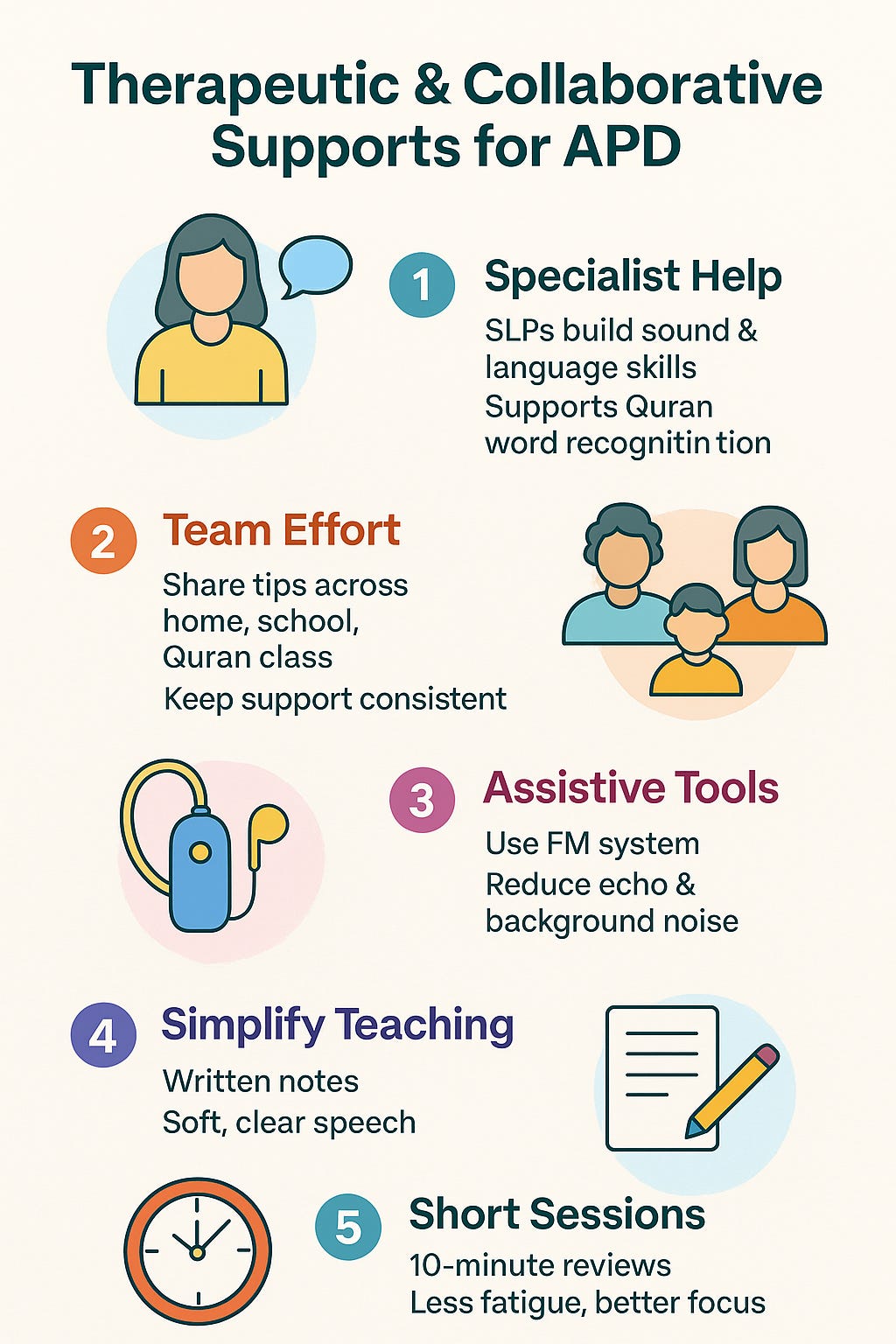
Above all, maintain empathy and an open mind. Quran learning is a spiritual journey as well as an educational one. For a child with APD, the journey may have extra obstacles, but it can also be deeply rewarding as they overcome them. Remind the child (and yourself) that Allah rewards effort and perseverance; the process of struggling and then succeeding even little by little is very valuable. By implementing these supportive strategies, you are not only helping the child learn the Quran – you’re teaching them that they are cared for and that different learners can learn the Word of God too. In the next section, we’ll look at a couple of case studies that illustrate how these strategies come together in real life, showing that with patience and the right approach, children with APD can indeed blossom in their Quran studies.
In conclusion, Quran learning for children with Auditory Processing Disorder is certainly challenging when “the ears don’t cooperate,” but it is far from impossible. With awareness, empathy, and informed strategies, parents and teachers can ensure that no child is left behind in experiencing the beauty of the Quran. These children may teach us new ways of listening – with our eyes, with our hearts, and with creative tools – and in doing so, perhaps we all gain a deeper appreciation for the miracle of hearing and understanding. When we accommodate their needs, we uphold the Quran’s universal message of mercy and guidance, ensuring it reaches every ear – and every heart – in the way that is best for them.
References
American Speech-Language-Hearing Association (ASHA). Central Auditory Processing Disorder. ASHA Practice Portal. (Prevalence rates and definition of CAPD)
Sertoma Speech & Hearing Centers. Auditory Processing Disorder (Infographic: Symptoms, Diagnosis, Types and Treatment). Blog post, June 14, 2022. (APD affects 7–10% of children; difficulty making sense of auditory information)ASHA (2005). Central Auditory Processing Disorder definition and diagnostic criteria (deficits in sound localization, discrimination, pattern recognition, etc.)
ASHA Practice Portal. Signs and Symptoms of CAPD. (Difficulties understanding speech in noise, following complex directions, learning songs/rhymes, etc.)Xxpressions Blog – Desmond Fambrini. “The Second Language I Learned With Auditory Processing Disorder.” May 10, 2022. (Discusses causes of APD like ear infections, and that APD has no cure, but strategies like ASL help
Solace Islamic Assistance (WordPress). “Learning disabilities awareness – Auditory Processing Disorder – Difficulty hearing differences between sounds.” October 3, 2017. (Simple description of APD for a general audience)
Aetna Clinical Policy Bulletin #0668: Auditory Processing Disorder (APD). (Overview of APD, lack of established therapies, current approaches like signal enhancement, auditory training, etc.)
Johnston, K.N., et al. Multiple benefits of personal FM system use by children with auditory processing disorder (APD). International Journal of Audiology, 2009;48(6):371-383. (Study demonstrating improved speech perception in noise, academic performance, and psychosocial outcomes with FM system use in children with APD)
Sharma, M., et al. A Randomized Control Trial of Interventions in School-Aged Children with APD. International Journal of Audiology, 2012. (Provides evidence on effectiveness of interventions; not directly quoted above but informs evidence-based practices).
Schochat, E., et al. Effect of auditory training on the middle latency response in children with (C)APD. Developmental Neuropsychology, 2010. (Demonstrated neurophysiological improvements in brain’s response to sound after auditory training in APD children)Bigras, J. et al. Interventions for School-Aged Children with Auditory Processing Disorder: A Scoping Review. Healthcare (Basel), 2024; 12(12):1161. (Summarizes categories of interventions: single/multiple-ability training, assistive devices, top-down and multimodal interventions; suggests combined approaches are beneficial)All About Learning Press – Marie Rippel. “Auditory Processing Disorder: 10 Ways to Help Your Child.” (Educational blog providing practical tips for teaching children with APD, such as speaking slowly, using visual aids, one-step instructions, etc.)Hear & Now (Hear Pure Kids). “FM Systems Benefits – How do FM systems help APD?” (Describes in plain language the advantages of FM systems for children with APD: improved sound quality, reduced fatigue, better engagement)
British Society of Audiology (2011). Practice Guidance: An Overview of Current Management of APD. (Recommends multidisciplinary management including environmental modifications and compensatory strategies; aligns with points above).
Holy Quran – While not a study, it’s the primary text involved in the learning process discussed. Various translations and interpretations were indirectly referenced for educational context (e.g., Surah names, verses for examples).